
Article · Takeaways
Web Summit: Agentic AI, AI Factory Architectures, Physical AI and 6G
My Web Summit takeaways through an energy and industrial lens: agentic AI’s potential and risks, competing AI factory architectures, the growing physical AI ecosystem, and why 6G is now on my watch list.
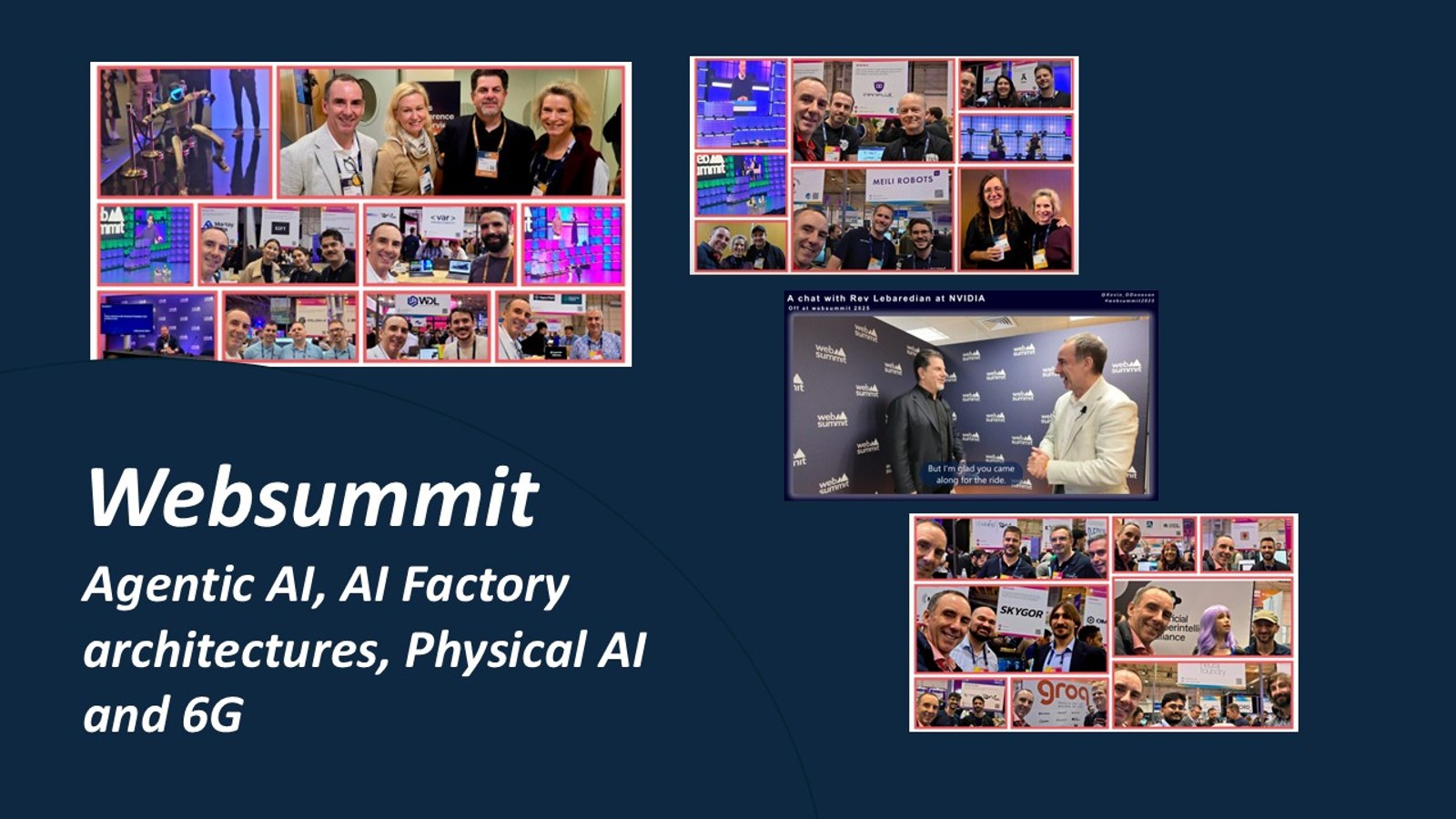
AI was everywhere at Web Summit: on the main stages, in the start-up booths and in the side conversations over coffee. But “AI” on its own doesn’t really mean anything anymore. You have to break it down into what kind of AI, running where and doing what.
Obviously, given what I’m usually focused on, I was also on the lookout for all things digital twin, industrial AI and energy tech. I came across a couple of interesting new start-ups, including UPWIND Energy, which is looking at new approaches around renewable energy technologies.
There were also quite a few companies talking about platforms for digital twins: the usual mix of data platforms, modelling environments and “single pane of glass” pitches.
Before going into my key takeaways, a quick note if you’ve never been to Web Summit.
You’ve got thousands of start-ups, and most of them are at the Alpha stage. That means they have an idea, a pitch deck and a dream, so they’re looking for investors. Some Alpha-stage start-ups will have a shipping product, but many may not yet have a minimum viable product.
Then there are the Beta start-ups, which typically have a solid MVP, early customers and are generating revenue. On top of all the start-ups, you’ve got quite a few scale-ups and established enterprise players there too.
A lot of what you see at Web Summit is a vision of “here’s what we think the world will look like in a few years’ time.” With that in mind, here are my own takeaways from the week.
1. Agentic AI: hype, potential and a few red flags
If I had to pick one dominant theme, it would be agentic AI. AI in general was all-encompassing at Web Summit, but when you start slicing it up, agents were the thing people kept coming back to.
Everywhere you turned, someone was talking about how their agents would improve workflows, automate processes or act as smart co-workers. A lot of it was genuinely fascinating.
At the same time, you have to remember the Web Summit context. Most of the agent start-ups are Alpha stage: lots of ideas and concepts, but nothing you’re going to deploy today. Beta-stage companies and larger players are further along, but even there, a lot of what’s being discussed is still in the early days of robust, day-to-day business use.
On the more established side, companies such as Atlassian and Replit were talking about how they’re weaving agents into their platforms. Manus AI was a company I wasn’t aware of before, and it is now firmly on my radar. I’ve signed up for its trial to see what it’s actually doing.
Now, confession time: I haven’t really dived into agentic AI for my own workflows yet. I’m not yet connecting my email, notes, tasks and everything else into a web of agents that go off and “do stuff” for me in the background.
But the more I listen to people who are doing this, and hear what they’re getting out of it, the more I feel I need to start experimenting.
If you’re looking for an early New Year’s resolution, “start dabbling with agentic AI” wouldn’t be the worst idea.
That said, there are some big open questions I need to work through for myself.
I run a small business. I have cybersecurity and data confidentiality obligations to clients. Before I plug my emails, notes and documents into someone’s agent platform, I need to understand where my data is going, who has access and what’s logged.
Remember, a lot of these agents are essentially wrappers around existing large language models, whether that’s ChatGPT, Claude, Mistral AI or whatever your favourite model is today.
That brings me back to a point I made some months ago. If you don’t control the system prompt and configuration of the LLM you’re relying on in the cloud, you don’t really have sovereignty over how it behaves.
The model may decide to take shortcuts, give you a “best guess” or gloss over uncertainty, and you may never know where that happened in a multi-step agent workflow. If you then bake that uncertainty into an automated agentic process, you’re going to have fun.
If the agent produces something poor or wrong halfway through the chain, what are you going to end up with by the time it’s done? And how much of whatever is done will you need to double-check manually?
Before someone jumps in and tells me all of this can be resolved through enterprise editions, APIs or having other LLMs check an agent’s output, I get it. But in my opinion, people will have to better understand what’s going on under the covers before they trust it all.
2. AI factory architectures: it’s not just one horse in the race
The second big theme for me was AI factories and architectures: basically, what the next generation of data centres for AI is going to look like.
Obviously, NVIDIA is the main game in town right now. If you’re building a large AI training or inference cluster today, chances are you’re talking about NVIDIA architectures and software. NVIDIA has done an excellent job, so this is just the reality of where we are.
But it was fascinating to see how many companies are working on alternative products or complementary technologies. A few stood out:
TensorWave was talking about how it is building new data centres based on AMD technology.
Nicolas M. from Arago, a French photonics company, presented how it is bringing photonics chip designs into the world of AI compute.
Groq explained how it uses its own LMUs, or Language Processing Units, to build inference data centres.
Qualcomm talked about how it plans to bring its new AI inference chips to the data centre in 2026.
On top of that, I came across Infiniflux, a start-up looking at a whole new way of doing two-phase cooling versus the more traditional single-phase cooling you see in data centres today. Given the energy and thermal challenges of AI compute, that caught my attention.
There was also an excellent session from Chris Ballance at IonQ, who spoke about its new quantum chip and focused on how energy-efficient it is for certain use cases and algorithms.
It’s still early days for practical quantum in mainstream AI workflows, but it was notable that IonQ was framing it in terms of energy efficiency and specific algorithmic niches, not just “quantum because quantum.”
Put all of this together and you get a very different picture from the simple “AI factory equals NVIDIA” narrative.
Yes, NVIDIA is dominant today. But there is serious money, engineering effort and ambition going into alternative architectures, from AMD-based platforms and photonics to specialised inference silicon, quantum-assisted approaches and even how we cool these systems.
If you thought the AI factory race was just about who is going to build what and where, think again. The debate about what gets built on which architecture is only heating up.
I drafted this after Web Summit, so what Google announced with its tensor processing units the following week has just added to this debate. It’s game on.
3. Robotics and physical AI
The third theme was robotics, or what NVIDIA and others are now calling physical AI.
It was genuinely heartening to see so much robotics presence at Web Summit. To be fair, I was actively looking for it, but it was still encouraging to see how visible it has become.
A lot of this was driven by the bigger players.
I had a chat with Rev Lebaredian from NVIDIA about physical AI, DSX, AI sovereignty and more. He was on stage with Peter Körte, the Siemens CTO and CSO, talking about AI for industrial environments: essentially, how these technologies play out on the factory floor and in real industrial settings.
The CEO of Boston Dynamics was there sharing the company’s view. Amazon Robotics lead Tye Brady was on stage and gave a really good press conference. Unitree Robotics was there too, with the G1 once again trying a few shapes on the show floor.
Beyond the big names, there were a number of companies with different types of robots for different use cases: some Alpha, some Beta, and a mix of ideas, demonstrations and early products.
The Technical University of Lisbon also had a stand with a bunch of robots, showing what it is doing around robotics in education. It was nice to see universities not just talking theory, but actually showing physical platforms in action.
I also came across two companies, Skygor and Neural Foundry, focused on different ways of controlling robotic swarms or fleets. This is essentially the orchestration and management of multiple robots working together, rather than just a single robot in isolation.
That whole idea of coordinating fleets, assigning tasks and managing mixed environments of different robot types is clearly starting to get more attention.
One of the more interesting angles came from Ben Goertzel at SingularityNET, which was there with Desdemona, its humanoid robot. I had a chat with the team about what it is exploring: namely, how people interact with a very human-like robot.
That human-robot interaction dimension is something we’re going to see a lot more of. The team will be at CES, so I’ll be following up there.
All of this raises the question: when we talk about robots, what do we actually mean?
Is it an arm-based robot bolted to the floor?
Something that walks?
Something that crawls?
Something on wheels?
Swarms or fleets of mixed robots?
There were plenty of discussions around physical AI being very different from the kind of AI you need for a large language model. Moving atoms around the real world is a very different problem from moving tokens around in a transformer.
The approaches also varied a lot. Amazon, for instance, does the vast majority of the design, manufacturing and operations for its robots in-house.
Other companies are piecing together solutions from off-the-shelf components, with players such as NVIDIA providing a lot of the plumbing: the platforms, tools, models and blueprints for companies to build their own robots and physical AI systems on top of NVIDIA technology.
Long story short: robotics and physical AI are not going away. If anything, they’re becoming a much more visible and serious part of the AI story.
4. 6G: the fabric for an agentic, AI-first world
The final theme that really stuck with me was 6G, and this one actually surprised me. It wasn’t something I went to Web Summit expecting to spend time thinking about.
The topic came up in the Centre Stage presentation from Cristiano Amon, the CEO of Qualcomm, and again in the press conference. The message was simple: 6G is coming.
We’re still talking five to six years away, but there is already a lot of development work underway. What really got my attention was how he framed the two main drivers for 6G.
Better voice quality
The argument was that we will be talking to our devices a lot more: phones, headsets, wearables, you name it.
We won’t just be talking person to person. We’ll be talking over the network to our AI agents. For continuous voice interaction to become the norm, the quality, latency and reliability of that audio really matter.
More context and data about your environment
6G is being designed so the network characteristics provide far more data and context to you and your agents about your current environment.
Think about all the signals around you:
IoT data
Weather
Traffic
Local conditions in a building, on a street or while out and about
Your agents will need that contextual information to be genuinely useful. The idea is that the 6G network will act as the fabric that lets all of that data flow around in a timely and contextual way.
There’s still a lot to be worked out technically, commercially and from a policy point of view, but the direction of travel was clear: more voice, more agents and more context, with 6G positioned as the connective tissue tying it all together.
For me, the main takeaway was that 6G has now moved onto my “keep an eye on this” list. I want to see how it evolves, and how closely it ends up being tied to the agentic and physical AI use cases everyone was talking about elsewhere at the event.
To wrap up
All in all, it was three very insightful and fun days.
Web Summit is unique in terms of the sheer number of new ideas and people with new ways of doing things and challenging the status quo.
The cynical, experienced person will say, “Oh, we tried that before and it didn’t work,” or, “No, you don’t understand our industry. That’ll never work.”
But as you walk into Web Summit, you pass what it calls the Web Summit Hall of Fame. It shows many of the leaders of massive companies today who turned up at Web Summit over the years with some crazy ideas: ideas that a lot of people probably thought at the time would never work.
Now they are leading some of the biggest companies on the planet.
So, never say never. As I often say, I don’t know what I don’t know. Long may the optimism, the change that’s needed and the new ideas from the new kids on the block prevail.
Anyway, these were my takeaways with my energy and industrial lens on.
What stood out for you? Do you have any comments or questions on anything I’ve said? Which of these themes do you think will have the biggest impact in 2026 and beyond?
As always, any and all feedback is welcome.
Kev.