Article · Takeaways · Paid Collaboration
The Things I Can’t Unsee After GTC
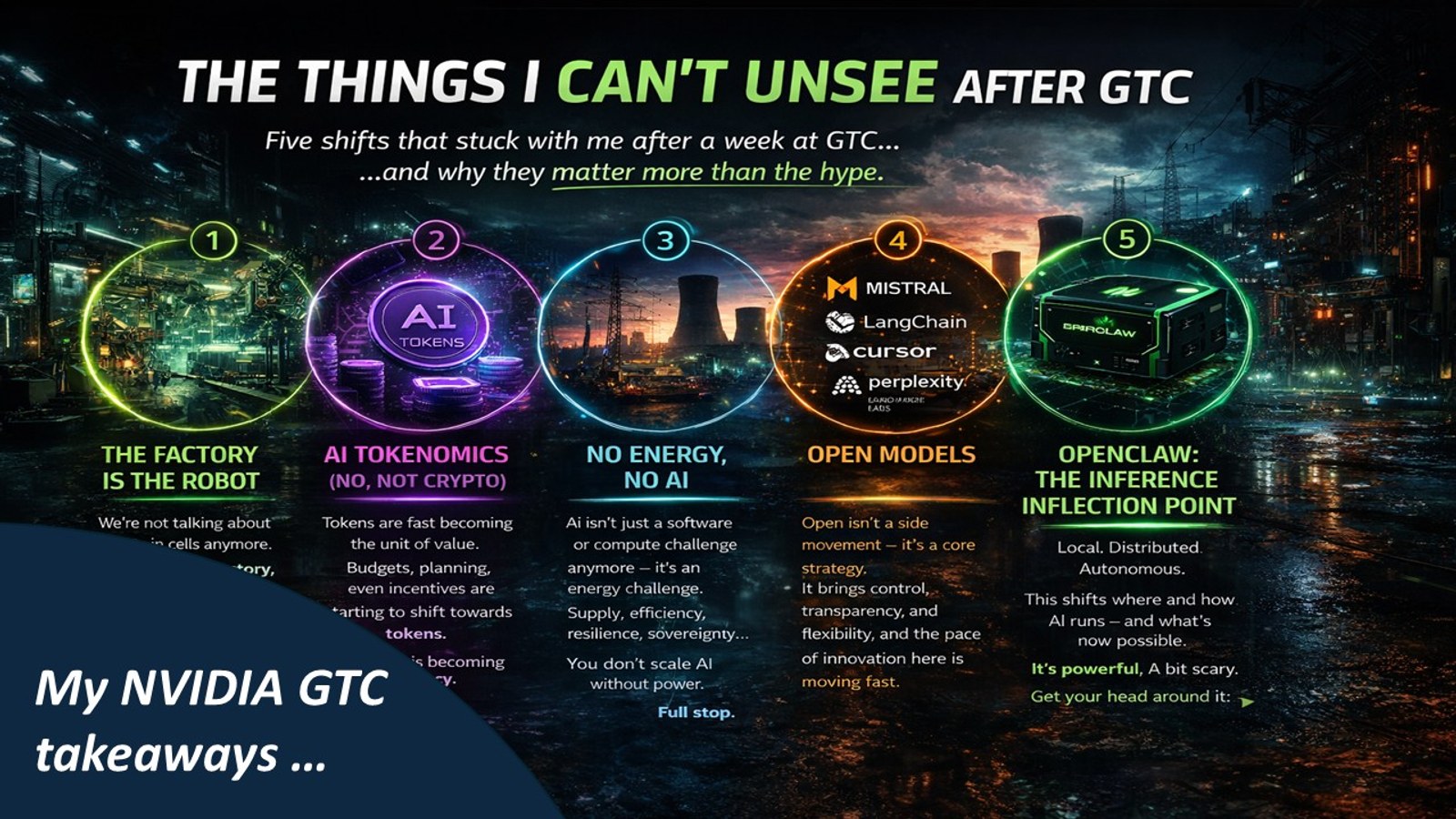
After stepping back from NVIDIA GTC 2026, five shifts still stand out: the factory as a robot, AI tokenomics, energy as a constraint, open models and distributed inference.
GTC was one excellent week. While I got my immediate takeaways out on the Saturday, over the past two weeks it’s been good to step away from the noise, the demos, the conversations and the sheer intensity of the week, just to process it all properly.
Because events like GTC can be overwhelming. In the moment, everything feels important. Everything feels like a breakthrough. But when you take a step back, patterns start to emerge. Some things fade away quickly. Others stick.
And as an “infamous” Irish politician once said, “on mature recollection”, I’ll stick with what I called out on that Saturday afternoon in San Francisco.
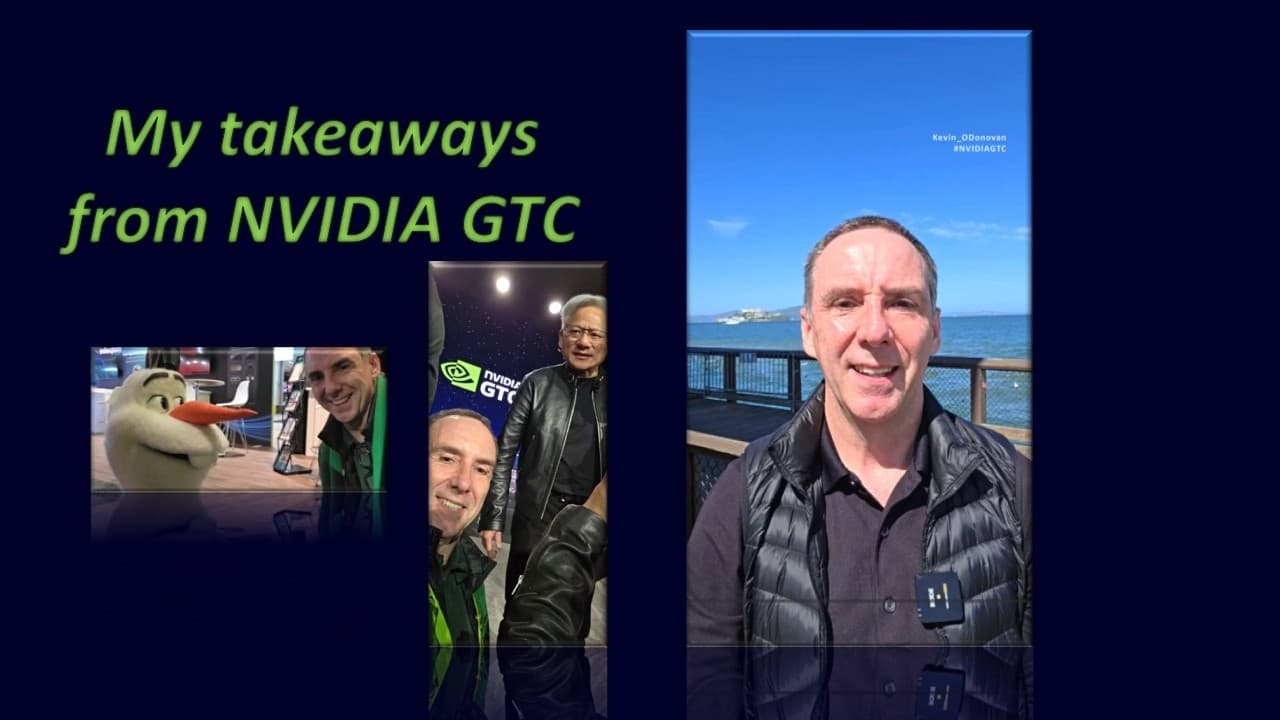
For transparency, I was at the event on NVIDIA’s excellent Creator program as a guest of NVIDIA EMEA.
1. The Factory Is the Robot
This one has been rattling around in my head ever since. It came up multiple times during the week: in keynotes, in conversations and in off-the-record chats. But it only really landed when I stepped back and looked at it as a whole.
We’ve spent years talking about automation in terms of individual assets. A robot here. A production line there. Maybe a bit of orchestration layered on top. But this is different.
The idea is simple on the surface: the factory itself becomes the robot. Not metaphorically, but architecturally. A system made up of systems. Machines, sensors, software, agents and assistants all working together as a coordinated whole.
And once you start looking at it that way, it changes the questions you ask.
You stop thinking about optimising individual components and start thinking about orchestrating behaviour across an entire environment. You start thinking in terms of coordination, simulation and continuous adaptation. You start asking what the “operating system” of a factory actually looks like.
Call it hype if you want, but there’s something deeper going on here. This is Industrial AI and Physical AI moving from isolated deployments into fully integrated environments.
So we’re not just talking about smarter factories. We’re talking about factories that behave as intelligent systems in their own right.
2. AI Tokenomics: Compute Becomes Currency
This was probably the most subtle shift, and potentially one of the most important.
And no, this is not crypto. Not blockchain. Nothing speculative.
Just a very practical shift in how value is measured and allocated, now via AI tokens.
What struck me wasn’t the concept itself. We’ve all heard about tokens in the context of AI. It was how quickly it may become embedded in real decision-making.
Budgets being discussed in terms of token allocation. Teams thinking about usage in terms of cost per token and return per token. Even early signs of incentives being structured around token access rather than traditional compensation models.
And when you sit with that for a minute, you realise what’s happening. Compute is becoming an economic unit. Not hidden behind infrastructure. Not abstracted away. But directly visible and measurable.
This has implications far beyond AI teams. Because once compute becomes currency, it starts influencing behaviour. It shapes priorities. It forces trade-offs. It changes how organisations think about efficiency and value creation. It’s not about my return on my dollar budget anymore. It’s about my return per token used.
Now, this is still very early doors. But from chatting with people at GTC, it’s already moving from theory into practice among many of the new kids on the block. And it’s going to catch a lot of people in our traditional industries off guard.
3. No Energy, No AI
This one shouldn’t be a surprise. But the scale of focus around it was.
Energy wasn’t a side conversation at GTC this year. It was central.
Everywhere you turned, there were discussions about supply, efficiency, grid capacity, sovereignty and resilience. Not as abstract concerns, but as immediate constraints.
And that’s the key shift. For a long time, AI has been framed as a software problem. Or, at most, a compute problem. But now, given all that’s going on, increasingly it’s an energy problem. And a sovereignty problem.
And not just in terms of consumption, but in terms of infrastructure, distribution and long-term sustainability.
Because the reality is simple.
You don’t scale AI without power.
And this is not just about the demands of AI factories or data centres. As inference workloads grow rapidly, especially out at the edge in factories and grids, and as more industries begin to adopt these technologies at scale, the pressure on energy systems is only going one way.
Up.
For those of us in energy and industrial sectors, this is where things get interesting. Because it puts our world right at the centre of the AI conversation. Not adjacent to it. Not supporting it. Central to it.
4. Open Models Are Not a Side Story Anymore
One of the more telling moments for me was sitting in and listening to the open models panel.
A genuinely impressive group of companies, including Mistral AI, LangChain, Perplexity AI and many others, all laying out how they see the space evolving.
What stood out wasn’t just the ambition. It was the confidence.
There’s a clear belief here that open models are not just an alternative approach. They are a foundational part of how this ecosystem develops.
And when you think about it in the context of enterprise and sovereign AI, it makes sense. Control matters. Transparency matters. Flexibility matters.
Closed systems will always have a role. But open models unlock something different: the ability to build, adapt and integrate in ways that align with specific organisational or national needs.
And the pace at which this space is moving is striking. This isn’t a slow-burn trend.
It’s accelerating.
5. OpenClaw: The Inflection Point for Inference
This is the one I’m still getting my head around. Partly because it’s not just theoretical. It’s already showing up in very practical ways.
Over the past few months, I’ve been hearing more and more about OpenClaw. Seeing early use cases. Watching how people are starting to experiment with it, including my wife, who is way ahead of me on this.
But being at GTC and seeing the broader context around it made something click.
This isn’t just another tool. It’s a shift in where and how AI operates.
Local. Distributed. Autonomous.
And that changes the equation.
Because it moves capability closer to the user. It reduces dependency on centralised infrastructure. It enables new types of applications, and a whole lot of new types of risks.
If I’m honest, there’s a part of this that feels slightly scary. Not because it’s negative, but because it’s powerful. And power, when it becomes widely accessible, tends to move faster than governance.
So if there’s one thing I’d say here, it’s this:
Don’t ignore it. Take the time to understand it. Experiment with it. Get a feel for what it can do. But do it properly, because this feels like one of those moments where the implications will only become clear in hindsight.
To Wrap This All Up
Stepping back from the individual takeaways, there’s a broader theme running through all of this.
Convergence.
Technologies that were previously separate, including AI models, simulation, robotics, networking and energy systems, are now intersecting in very real ways. And when they intersect, things don’t just evolve. They accelerate.
That’s what makes this moment different. It’s not one breakthrough. It’s multiple things advancing at the same time, in parallel and interrelated, all starting to reinforce each other.
And a Quick Reality Check
Now, it’s worth grounding this. Weeks like GTC can create a very particular perspective. You’re surrounded by people at the forefront of what’s possible. You’re seeing the best-case scenarios. And yes, a lot of Kool-Aid was consumed.
So with all this, it’s easy to forget that most organisations are still dealing with very real, very immediate challenges. Keeping systems running. Managing costs. Navigating complexity.
But that doesn’t make the underlying shifts any less real.
It just means the journey from here to widespread adoption will be uneven.
What Comes Next
I’m still working through a lot of material from the week: notes, conversations and a bunch of interviews that I’ll be sharing over the coming weeks.
But more importantly, I’ve started to think about what all of this actually means in practice. Particularly for the world I spend most of my time in: energy, industry and infrastructure.
Because if these trends play out the way they look like they might, then the implications for the industrial metaverse are significant.
That’s what I’ll dig into next, in the next edition scheduled for Monday, 6 April.
For now, though, these are the things I can’t unsee from GTC.
And once you see them, it’s very hard to go back.
My two cents,
Kev.