
Article
The Industrial Metaverse Is Here to Stay. Now We Need the Plumbing
The technologies behind the industrial metaverse are converging. The practical challenge now is connecting models, data, simulation, AI and operational workflows in a way that scales.
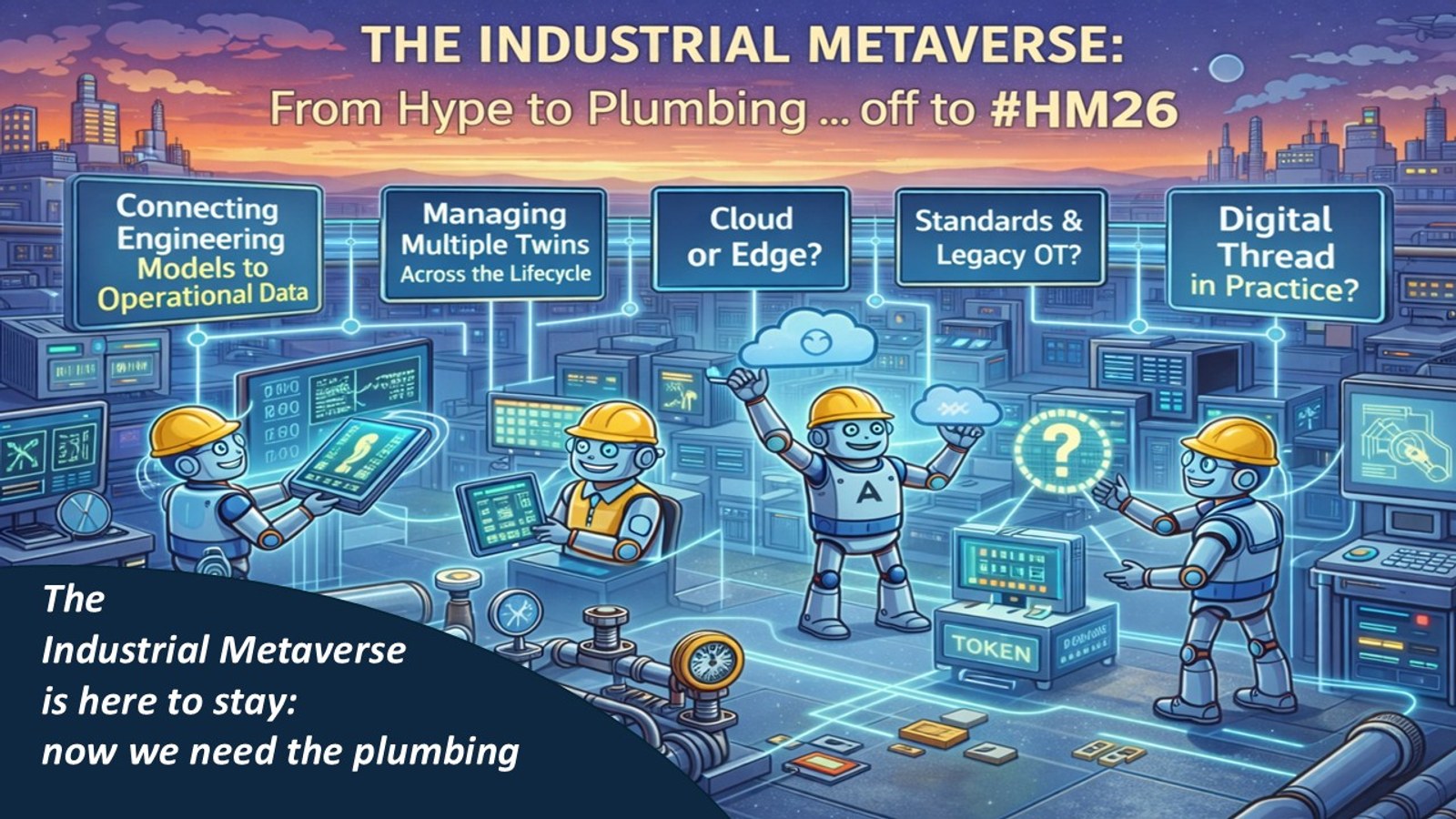
As I sit here in Nice airport, waiting to board my flight to Hannover, one question keeps coming back to me:
Where are we, really, with what I’d call an industrial metaverse stack?
Now, when I talk about an industrial metaverse stack, I am not talking about inventing some brand-new reference architecture, or replacing established IT/OT models like ISA-95, RAMI 4.0, or any of the other standards and frameworks industry already relies on.
I am talking about how the newer layers now being added around simulation, AI, digital twins, spatial interfaces, and real-time operational data are starting to sit across, connect into, and build on top of what already exists.
Because while the market is still full of confusion around terminology—digital twins, industrial AI, simulation, agentic AI, AI-native, digital thread, spatial computing, physical AI, embodied AI, the “factory is the robot,” or whatever the term of the week happens to be—the underlying direction of travel is becoming clearer.
Convergence is real
We are no longer dealing with isolated technology conversations, with the digital twin team in one room, the AI team in another, robotics off somewhere else, and edge compute left sitting in the corner.
That world is fading fast. These things are now starting to stack together. More importantly, they are starting to reinforce one another.
For years, the industrial metaverse conversation has been fragmented. One company focused on simulation, another on visualization, another on robotics, another on industrial IoT, another on AI, another on reality capture. The list goes on.
All valid. But the real value will only start to show up when these things stop being treated as separate innovation tracks and start becoming part of one broader operational stack.
The more interesting questions now are these
How are you connecting engineering models to operational data in a way that survives contact with reality?
How are you managing multiple twins across the lifecycle rather than pretending there is one magical model?
Where does simulation sit, where does AI sit, and what lives at the edge versus in the cloud?
What standards are you leaning on, and how are you dealing with the brownfield “fun” of legacy OT environments?
What does the digital thread actually look like in practice, not just in a PowerPoint slide with nice graphics?
I’ve been asking people these questions for a while now, and every time I ask a different company, I get a different answer.
And that is not necessarily a bad thing. Different industries have different constraints. Different companies have different histories, different levels of maturity, different politics, different technical debt, and different ambitions.
But it does underline one important point. We are still in the phase where the broader stack is being worked out.
We have patterns emerging. We have way better tools than we did a few years ago. More realistic simulation. More capable AI. More openness. Way more compute. Better standards. In short, more of the building blocks are now there.
Which all means we have more pressure than ever to break down silos. But we are still figuring out how to assemble all of this in a way that scales.
Why the plumbing matters
Because the industrial metaverse is becoming less about a futuristic vision and more about a practical way to make better connected industrial decision-making. Digital twins are becoming more widespread, but the conversation needs to mature beyond labels and toward capabilities, integration, and lifecycle usefulness.
AI is becoming more important not just because it can automate, but because it can challenge, connect, and improve decisions across silos. And that is where the plumbing either holds it all together… or it doesn’t.
The connective tissue between models, data, systems, simulation, and operational workflows is where much of the real value will either be created or lost.
It is time to move beyond talking about the industrial metaverse only as the “art of the possible” and focus instead on what it can actually make real today.
Because that, in the end, is where the industrial metaverse either becomes useful or stays stuck in marketing.
My own view is pretty simple. The convergence is real. And while there is still a lot of confusion around definitions, stacks, and starting points, we are a lot closer to something practical than many people seem to realize.
The Industrial Metaverse is here to stay.
And if you are at Hannover Messe this week and want to chat about any of this, let me know.
Kev.