
Article
The Metaverse Didn’t Die. It Went to Work.
Consumer VR may have lost momentum, but the technologies behind the industrial metaverse are accelerating across factories, energy plants and infrastructure.
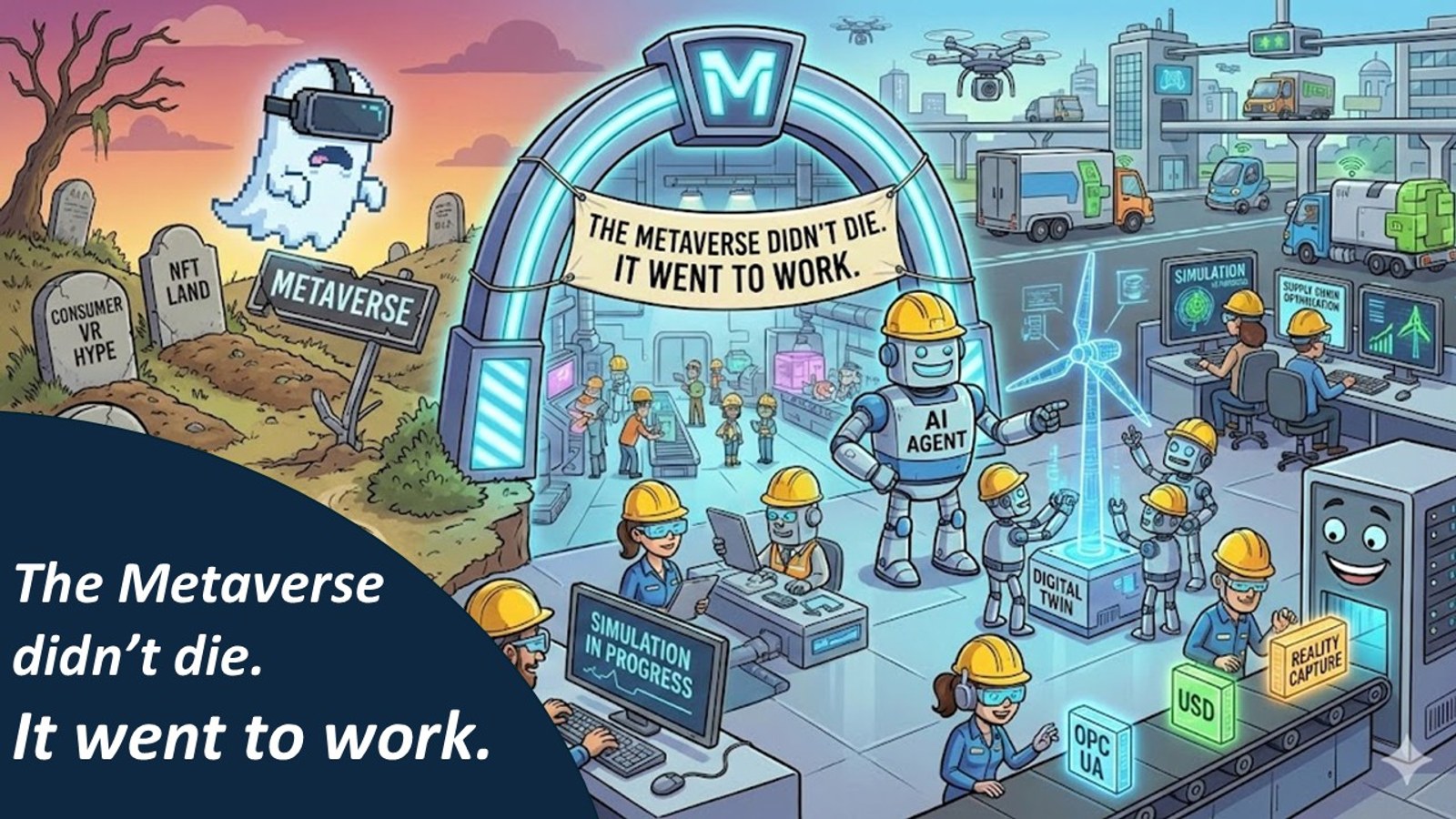
We’ve all seen the “metaverse is dead again” or “where did it all go wrong?” headlines in the past week. But once again, in my opinion, this is missing the point entirely.
Meta layoffs at Reality Labs have triggered the usual flood of articles gleefully declaring the end of the metaverse. The narrative is depressingly predictable: consumer VR hasn’t hit mass adoption, investment is tightening, therefore the whole idea must have been a fad. Cue the metaphorical shovel.
Now, don’t get me wrong. For the folks who lost their jobs in the past few weeks, and for many colleagues out there building businesses around XR, it’s been a very tough 12 months.
But here’s the thing: if your definition of the metaverse starts and ends with cartoon avatars, virtual real estate speculation and people wandering around in headsets all day, sure, you might think it’s over. But that was never the real story, and it certainly wasn’t the important one.
Whatever label you want to slap on it — metaverse, industrial metaverse, Industry 5.0, spatial computing, Physical AI, embodied AI or cyber-physical systems — the underlying technologies that actually matter are accelerating quietly and steadily, with far more real-world impact than they get credit for.
Foundations, Not Hype
The biggest mistake early on was bundling everything together into a fragile narrative: VR headsets, social worlds, crypto, NFTs and digital fashion, all assumed to be inseparable. They weren’t. And I have been saying this since way back in 2020.
What actually matters, and still does, are the technologies underpinning real transformation.
Digital twins are now operational assets, not slideware. Physics-based simulation drives engineering, operations and planning. Reality capture is faster, cheaper and higher fidelity than ever. Graphics pipelines have reached a threshold where photorealism and real-time performance are no longer exotic.
This isn’t a collapse. It’s consolidation.
The Rise of Industrial Agents
When the metaverse hype first kicked off, generative AI wasn’t even on the radar. Sure, we had analytics, some computer vision and machine learning, but nothing like the foundation models, multimodal reasoning and natural-language interfaces we see today.
Now, AI can:
Generate geometry, environments and behaviours
Reason across text, images, video and 3D
Serve as the interface between humans and complex systems
Drop that into a spatial, digital-twin-rich environment and suddenly the proposition changes completely. Immersion isn’t about novelty; it’s about understanding. You can interact with systems in ways we’ve never had before, rather than wrestling with spreadsheets and dashboards.
Add in the better AI we now have at the edge, running closer to sensors, inside machines and inside robots. We’re moving beyond chatbots or generating nice graphics. It’s about “text to action.” An operator can ask, “Why is Unit 4 vibrating?” and the AI doesn’t just show a graph. It highlights the failing bearing in 3D, pulls the maintenance log and drafts a work order.
We now have the ability to create orchestrated Agentic AI: autonomous “digital workers” that live inside the digital twin, monitoring systems 24/7 and acting on problems before humans even notice them.
Compute Finally Makes Sense
Another inconvenient truth for obituary writers: the hardware is finally supporting the ambition.
Look at what NVIDIA, AMD, Qualcomm, Groq, DEEPX, Intel, Infineon, STM, Arm and many others are up to. We now have:
Vastly improved GPUs and NPUs
Dedicated edge AI accelerators
Hybrid cloud-edge architectures
Better power efficiency and deployment economics
New architectures for power electronics
And more
Many of the scenarios from a few years ago that were seen as the “art of the possible” — super cool but uneconomic — are now deployable at scale. And industrial players have quietly led the way.
Industrial Momentum Is Real
So, if the “metaverse” is dead, nobody told NVIDIA, Siemens, Yokogawa, Bentley Systems, Schneider Electric, Tesla, BYD, Mercedes, PepsiCo, ABB, ADNOC, John Deere or Caterpillar.
Just look at what these companies and their customers have been announcing and launching this past month, either at CES or at Davos last week.
What they’re building doesn’t look like consumer social VR. What it looks like is:
Digital twins tied directly to operational and engineering data
Simulation-driven design, commissioning and optimisation
Immersive environments for training, safety and decision support
AI embedded across the lifecycle
All linked together with a digital thread
Call all this whatever you want. We have plenty of marketing terms, but the architecture is unmistakable: digital twins, 3D and spatial worlds, persistent environments, real-time data, simulation, foundation models, industrial AI and humans in the loop.
Standards and Interoperability Are Unlocking the Full Potential
One of the most under-appreciated shifts is the rise of standards. For years, the biggest blocker to comprehensive digital twins wasn’t graphics or compute. It was silos: organisational silos, data silos, vendor silos and lifecycle silos.
Now, things are changing fast due to the adoption of technologies and approaches such as:
OPC UA and open industrial connectivity
Unified Namespace architectures
OpenUSD as a common 3D scene and model format
Digital thread concepts moving from theory to practice
And credit to the impact of AI in industries today. AI’s presence is accelerating the breakdown of silos. To get value from AI, organisations must integrate data across departments, companies and supply chains. That used to be uneconomic and a huge amount of work. It is still a huge amount of work, but now it’s a necessity.
The knock-on effect is that it’s finally feasible to build comprehensive, lifecycle-spanning digital twins, or multiple connected twins joined together with standards and a persistent digital thread. Design feeds engineering, engineering feeds operations, and operations feed optimisation and future design. A couple of years ago, this wasn’t realistic. Today, it is.
Reality Check: Autonomous Vehicles and Robots
Still think this is wishful thinking? Take a look at what’s actually deployed today:
Autonomous vehicles on our streets
Heavy machinery fleets from the likes of John Deere, Caterpillar and Doosan running autonomously
Industrial robots, collaborative robots, mobile robots and even humanoids operating in real-world conditions
Look at the technology stack enabling all of this: simulation, digital twins, sensor fusion, edge AI, real-time 3D environments and continuous data feedback loops.
And yet some people want to argue that “all the technologies that were going to power the metaverse are gone.” Sorry, folks, that’s just wrong.
Just walk into a modern factory. Between tariffs, geopolitics and the push to onshore or nearshore manufacturing, there’s an enormous amount of activity underway.
These facilities are designed end to end in digital twins and simulated long before anything gets built. Not just the layout, but the software, electrics, controls and AIs — everything. Once built, they use huge amounts of automation through robots, automated guided vehicles, autonomous material handling, PLCs, virtual PLCs, layered control systems, continuous optimisation and chatbots. Folks are now also doing proofs of concept with Agentic AI and humanoids. This is happening today.
You know, these robots are “inhabitants” of the physical world, but their minds live in the industrial metaverse. They learn in simulation, effectively living thousands of lifetimes in the cloud before downloading those skills to the physical robot.
If you genuinely believe that the technologies supposed to “power the metaverse” aren’t alive and well today, you’re not being sceptical. You are out of touch.
Back to VR: Immersive Experiences Are a Spectrum
Another persistent myth is that the metaverse has to be VR. It doesn’t. Immersion is a spectrum. Again, I have been saying for years that immersive experiences are a spectrum of how we consume the experience.
That ranges from experiencing 3D representations of virtual worlds and digital twins in real time on 2D screens, to 3D screens, AR on a phone or tablet, increasingly AI glasses, mixed reality and full-body immersive VR. They all exist today.
So, if anyone wants to argue that because we are not all experiencing all of this in VR the metaverse is “dead,” then, in my opinion, you are again missing the point. Engineers, operators and executives all need different interfaces. The wobble in the VR market doesn’t invalidate the rest. It simply resets expectations for VR, not what is actually going on in the wider industry.
Closing Comment
So, while some folks are off writing obituaries, serious teams are quietly building something far more interesting and far more valuable than the hype ever was.
And if you think I am off in “la-la land,” walk into a modern factory, an energy plant or a logistics hub. What you see might surprise you.
My two cents.
Kev.