
Article
Tech at Hyperspeed vs. Humans at Capacity: My Takeaways from DTECH 2026
Technology is accelerating, but the people being asked to understand, design and use it are already stretched. My DTECH 2026 takeaways on the utility productivity paradox, agentic AI, software-defined grids and giving people the time to adapt.
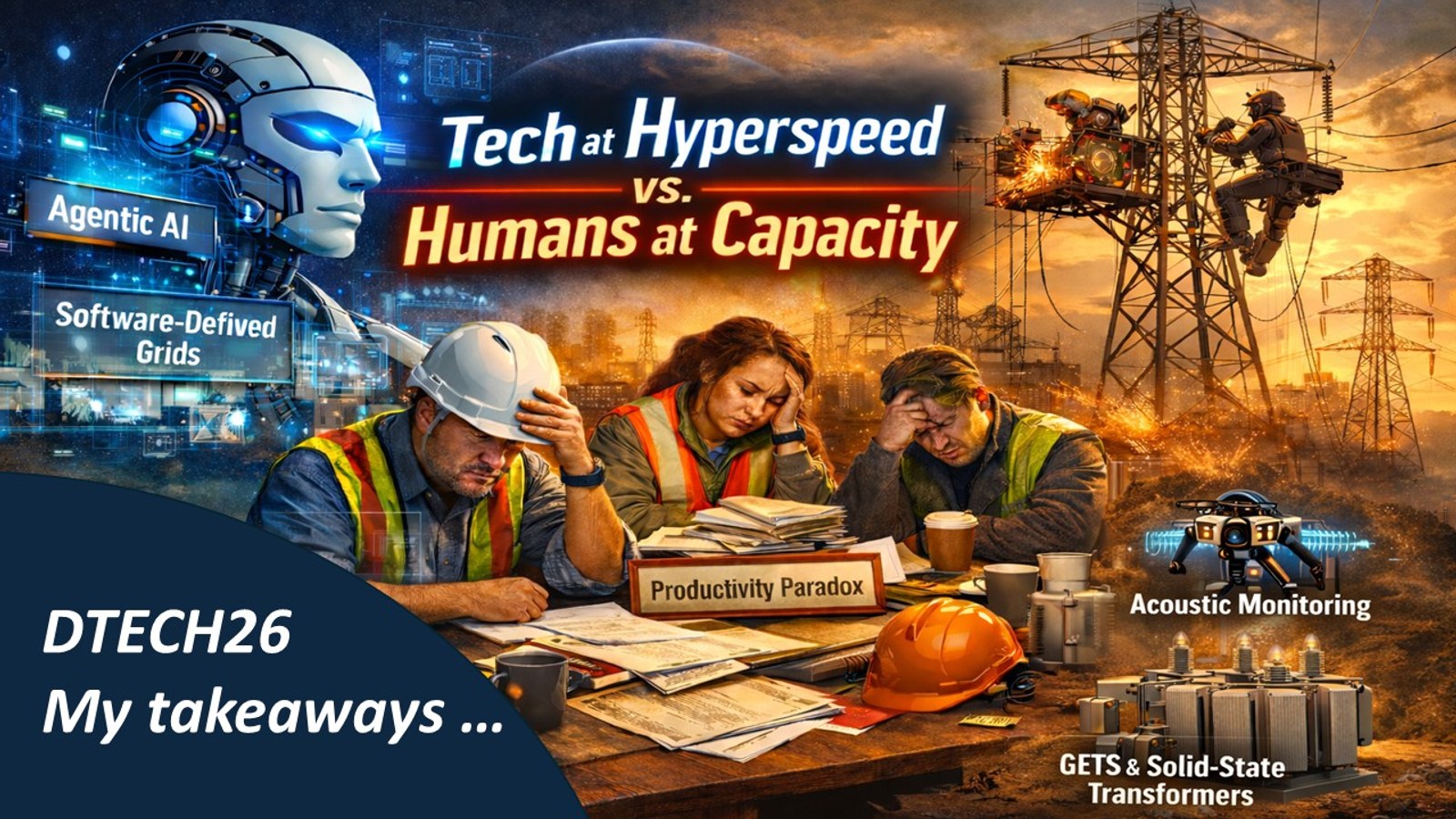
DTECH 2026 was one great week, and I came away from it well impressed and positive about what I saw and heard. That said, my overarching takeaway was that while the technology is accelerating at hyperspeed, the folks being asked to understand, design and use all this tech are being stretched to the limit.
Walking the floor, sitting in workshops and chatting with folks, I kept returning to the same realization: the people moving the grid forward today are doing one amazing job. And they are having to do it all in a “rebuilding the plane while flying it” mode, while managing an existing day job that has never been more complex or demanding.
A few weeks before DistribuTECH, Sonja Ernst and Jamie Hardy asked me on their Are We There Yet? podcast if we humans can deal with the current pace of change. I said at the time that I think us humans will muddle our way through, and I still honestly believe this.
But we can’t bury our heads in the sand either and assume any of the new “shiny toys” or tech is going to solve this overnight.
1. The productivity paradox: innovation in the trenches
The “productivity paradox” is often treated like a theoretical concept in a textbook. At DistribuTECH, I felt it as a very human issue. I spoke with dozens of utility folks who are passionate about new technologies. They want to innovate, but they are up against one of the most fundamental constraints in life: time. Their absolute dedication to keeping the lights on leaves precious little breathing room to experiment or implement something new.
On the ground, the reality is formidable:
Utilities are navigating a deep affordability crisis, balancing cost pressures with reliability expectations.
The uncertainty around global politics, trade restrictions and tariffs is not going away.
There is an ever-increasing demand for energy, be that via AI factories, onshoring manufacturing, more renewables, more EVs or more urbanization.
Supply chain issues are still causing headaches. From basic parts to specialized hardware, getting the right components at the right time is never trivial.
Regulatory oversight, reporting and accountability requirements are more demanding than ever, creating a parallel workload that leaves less time for innovation.
So just keeping up with the existing day job is a huge ask. But asking people to “find a few extra hours” to adopt new tech, new platforms, new systems or tools is unrealistic. As Marcus McCarthy from Siemens said to me:
This is a serious industry. When mistakes happen, people die.
Think about it: while we’re often focused on the latest “shiny new toy” and AI-enabled possibilities, the folks on the ground are balancing all these operational responsibilities, regulatory pressures and an ever-growing list of reporting and compliance requirements. That tension is real, and it’s got to be exhausting.
Now, of course, it all depends on what the use case is. If you’re going to deploy, say, agentic AI to order your coffee supply, weird things can happen, but it’s not a major risk. When you are talking about planning, operating and managing autonomous grids in real time, the stakes are entirely different. Mistakes here aren’t minor. They’re critical.
This is why the productivity paradox is so pronounced in utilities: the systems are complex, the stakes are high and the people responsible for them are already maxed out.
Many folks are out there doing exactly this today, moving the needle in their day jobs while simultaneously thinking bigger about enterprise architecture, agentic AI and software-defined grids. It’s not simple. It’s not fast. But it’s a hell of a lot of work.
Many other folks are not, so they will have to be given the time to learn, experiment safely and internalize how AI’s capabilities can help them. In my opinion, this comes down to their leadership acknowledging that this has to happen and enabling it to happen.
2. Agentic AI: think enterprise architecture, not use case
Speaking of “shiny toys”, the main tech buzz during the event was certainly agentic AI: AI that doesn’t just answer questions but can make recommendations or actually act autonomously, making decisions and carrying out tasks.
Companies like OATI with Genie, Siemens Energy with Noedra, IFS with Nexus Black and GE Vernova with GridOS were all there pushing the boundaries of what such technology and systems can do.
But I’d propose that we all need to think about agentic AI not in terms of how it can be used for a single use case, but as an enterprise architecture challenge. Organizations need to plan for hundreds of agents, including ones that haven’t been dreamed up yet. When agents start generating other agents, suddenly the distributed systems theory many of us learned years ago is front and centre again.
I’d argue that many folks are thinking about deploying agentic AI in one of two ways:
Overlay agents onto existing processes. You keep your current workflows mostly intact and use AI to augment what you already do. This is often where organizations start because it feels safer.
Redesign processes entirely around agentic AI. Instead of patching old workflows, you rethink operations from the ground up, structuring them to take full advantage of AI’s capabilities.
Most will gravitate towards option one, but the biggest productivity gains, and the transformative potential, are in option two.
And here’s the kicker: this isn’t about IT leading the charge. Large-scale transformations often stall when they’re dictated by IT or innovation offices in isolation. Real transformation is led by the people who run the business: operators, planners and asset managers. The ones who deeply understand what actually happens day to day.
They need to own the workflow redesign. They need to understand what AI can realistically do for them. And then they need to apply it directly to their processes. IT’s role is critical, but it’s to enable, secure and scale. Not to dictate.
In practical terms, this means mapping workflows across departmental silos, identifying where coordination is required and intentionally connecting those touchpoints. In many organizations today, this either isn’t done or isn’t done well. If it were, we wouldn’t be dealing with the silo challenges we see today. But this is exactly where meaningful transformation and real productivity gains will happen.
And the folks asked to do all this will need to understand both the operational details of workflows and how different AI technologies can be applied to improve them.
It’s not one or the other. It’s both.
3. Software-defined: the long game pays off
Virtualizing the substation has been a long journey, more than 15 years in the making. It was a hot topic way back in my Intel days, and finally the industry may be hitting a tipping point. Software-defined substations, once a distant vision, are now tangible realities.
At DistribuTECH, the signs were good:
The vPAC Alliance showcased a growing ecosystem of companies, solutions and standards, proving that interoperability and modularity are becoming real.
Siemens Smart Infrastructure had its new SIPROTEC V.
GE demonstrated its software-defined Grid-Beats APS.
Subnet Solutions showcased centralized management tools for both new virtualized and legacy hardware-based devices.
My point here: the long game does pay off. It’s not flashy or instant. But for those willing to stay the course, the infrastructure and tools are now in place to finally help open up a new era of productivity and agility in the grid.
Innovation in action: robots and transformers
Also, a shout-out to two technologies that caught my eye.
Acoustic monitoring
Boston Dynamics, in collaboration with Fluke, showcased robots equipped with beamforming acoustic sensors capable of detecting gas or air leaks down to a few centimetres.
GETs and solid-state transformers
Grid-enhancing technologies and solid-state transformers continue to advance. There’s still a trust and vetting challenge, but the potential to boost grid capacity without large-scale infrastructure builds is there.
Final thought
On my comment above that folks will have to be given the time to learn, experiment safely and internalize how AI’s capabilities can help them, and that this comes down to leadership acknowledging and enabling it: I am well aware this is easy for me to say and REALLY hard to do.
But I do believe that good leadership, with intentional planning, design, patience and empathy, can hopefully alleviate some of this productivity paradox. Not by rushing new tools and mandates at overloaded people, but by giving them the time, architecture and support to figure out how to use the tech effectively in their day job.
Otherwise, all the excitement about AI and automation risks becoming just noise, not value.
My two cents,
Kev.