
Article · Takeaways
Robots, Twins and Threads: My Outside-In Take on EMO 2025
My outside-in takeaways from five days at EMO 2025: astonishing machines, digital twins and simulation everywhere, persistent data silos, plenty of automation, and much less Physical AI and immersive technology than you might expect.
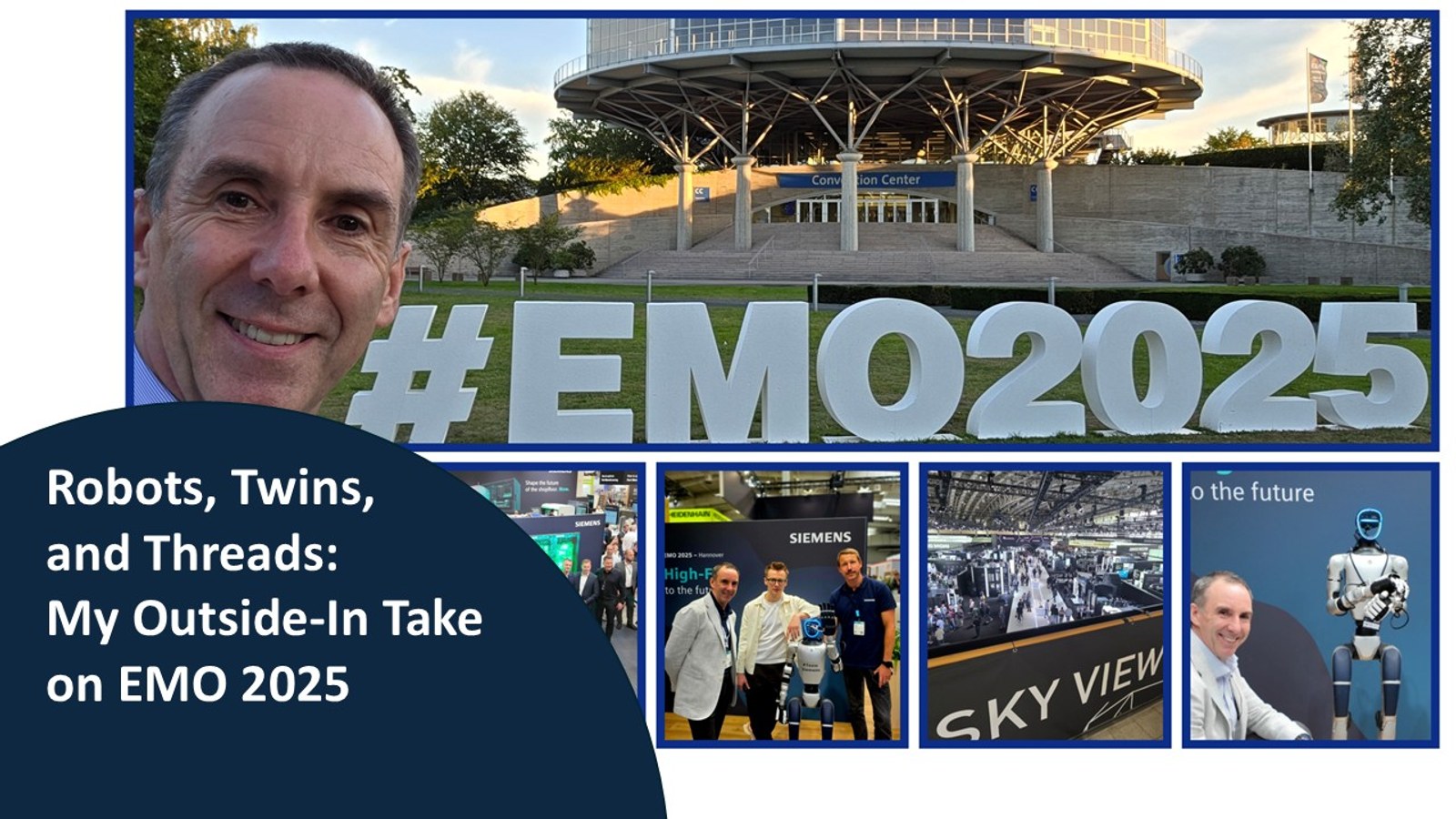
After five days at EMO 2025, here are my takeaways. And this is very much from an outside-in perspective, because the CNC machining world is not my usual beat.
The scale is mind-blowing
The first one: the scale of the machines and cells is mind-blowing. The amount of mechanization, digitalization and automation in these machines is VERY impressive.
Prior to last week, I did not understand the complexity in these machines. So, to see their size and the amount of mechanization, automation and digitalization across the board was eye-opening.
Many people have been talking about additive manufacturing over the past few years. So, getting to see the art of the possible there—and what is currently in production, like the SpaceX Falcon 9 rocket engine nozzles being 3D printed in metal—was fascinating.
And getting to better understand what 3D printing in metal allows you to do in terms of printing, milling and machining, all in one go, showed how mind-blowing the designs and capabilities enabled by this technology are.
Digital twins everywhere, but silos are still a big problem
The second one was around digital twins. Digital twins were everywhere.
Now, digital twins mean many things to many people. But, to cut a long story short, everything that’s designed to be manufactured is in a CAD model, 3D model or digital twin.
The amount of simulation being used was also great to see—from simulation of the design being produced, simulation of the G-code that will run the job on the machine, simulation of the robot’s movements and simulation of AMRs’ movements, to simulation of the entire production workflow and more.
So, lots of digital twins everywhere and simulation across the board.
And a shout-out to gemineers GmbH. They take all the data coming off a machining tool as an individual part is made and build a digital twin for that exact part, identical down to the micron level. This digital twin of the exact part can then be given to the end customer, enabling all sorts of use cases.
Now, do all of these digital twins hang together in a seamless process? No. Most of them are still in silos, but people are starting to break down those silos through APIs, more consistent standards and so on.
That leads me to the digital thread.
The digital thread
I got a good briefing from Davide Sferlazza at Siemens and chatted with Melanie Luz from Gebr. Heller Maschinenfabrik GmbH about what a digital thread is.
They see it as the thread that ties things together in the production process—and also how the technology starts to link everything together.
A lot more to follow on this in a week or so.
AI was front and centre, but no one is vibe-coding their factory
AI was a hot topic here. But again, AI means many things to many people.
A lot of the AI was of the machine learning variety—very clever machine learning—for predictive maintenance and so on. And there definitely is more and more AI technology being put into design tools, production planning tools, work scheduling tools, simulation software and more.
But it’s not that someone is here vibe-coding a new factory. That is not a thing anyone was talking about.
What folks were talking about was how to create specific industry foundation models that benefit the entire ecosystem.
Siemens announced the Data Alliance with a number of machine tool builders there, so there were a lot of discussions about how companies need to come together to create these for the industry.
That includes all the fun and games involved in pulling data together from everyone:
How much data does everyone share, and what kind?
How do companies maintain their IP?
What’s the business model around all of that?
Who pays, and who monetizes what?
So, loads of interesting discussions are going on.
Robotics everywhere—but not much Physical AI
Now to the things that weren’t here.
I spent some time hanging out with Siemens’ HuBSi, which is a G1 from Unitree Robotics—a humanoid and Physical AI robot. But that was the only one, to my knowledge, at the entire show.
There were A LOT of robots. Think everything from AGVs, AMRs and AIVs with swarm technology. Many companies had great examples of multiple robots all working together:
Moving tools around to machines
Loading tools
Feeding machines with new blanks of metal
Moving machined parts around
Taking away all the chips and waste
So, lots of automation, but no Physical AI.
Workforce training was hot—but there were few immersive experiences
The other thing: workforce training and the skills needed for the future were huge topics.
There were a couple of companies using immersive experiences. I saw a number of demos with a Vision Pro or a VR headset. Siemens was talking about the Industrial Metaverse, with a clever VR experience using real production data.
But it wasn’t that everybody was suddenly walking around with augmented reality glasses, the new Ray-Bans or whatever.
It’s still a huge challenge to capture knowledge, train people, maintain skills and bring in new skills.
As I’ve always said, as we see the different digital twins and digital 3D models being created, and as the silos break down, that’s the content you can then feed into an immersive experience.
Whether you’re looking at that on your mobile phone, on an augmented reality headset of the future or on a VR headset today, that’s all coming.
And a special shout-out to Rimon, who use a body-mounted 360 camera when recording a worker’s point of view to capture knowledge.
With a 360 video, you can edit the video in post-production to focus on what you want people to see. You don’t have to worry about framing the video as it’s recorded, as you would with a standard camera.
I had not seen that before. Very clever.
Challenging times, but clear growth areas
It’s a challenging time for the industry, with all the uncertainty and unpredictability around geopolitics, trade wars, tariffs and so on.
But it was interesting to hear a lot of people talking about growth industries. Obviously, aerospace and defence are seen as big growth industries today.
A lot of people were also talking about silicon manufacturing and the new technologies that have been brought in to enable the entire supply chain—not just wafers, but the machines that build the wafers, build the silicon chips, and, and, and.
DMG MORI World: A masterclass in storytelling
One final point: I have the opportunity to go to a lot of events across the globe, see a lot of things and meet a lot of cool people.
The DMG MORI World in Hall 2—I’ve not seen something like that in a long, long time. It was very impressive.
The entire orchestration of the layout, the focus on different industries, the visualizations and the tours all stood out. I got my personalized yo-yo from taking the DX tour.
Their overall storytelling, the amount of technology on display, the hall layout, the Skywalk view, the drone fly-throughs and what they were doing on Instagram and TikTok were very, very impressive. A lot of companies could learn a few tips and tricks from them.
Anyway, these were my main takeaways from my outside-in perspective, and I’m sure I’ve missed stuff.
So, if anyone has any questions or comments, or if you agree or disagree with anything, let me know.