
Article · Explainer
Power Flows, Physics and FACTS: Why AI for Transmission Grids Is Harder Than It Looks
I was recently involved in a workshop where the topic of conversation was on the transmission grid, the role of AI, and why modelling power flows is so complicated. Now most of the folks involved were not from the utility or power engineering world, yet the 'hard' question that kept coming up was, why is this so hard?
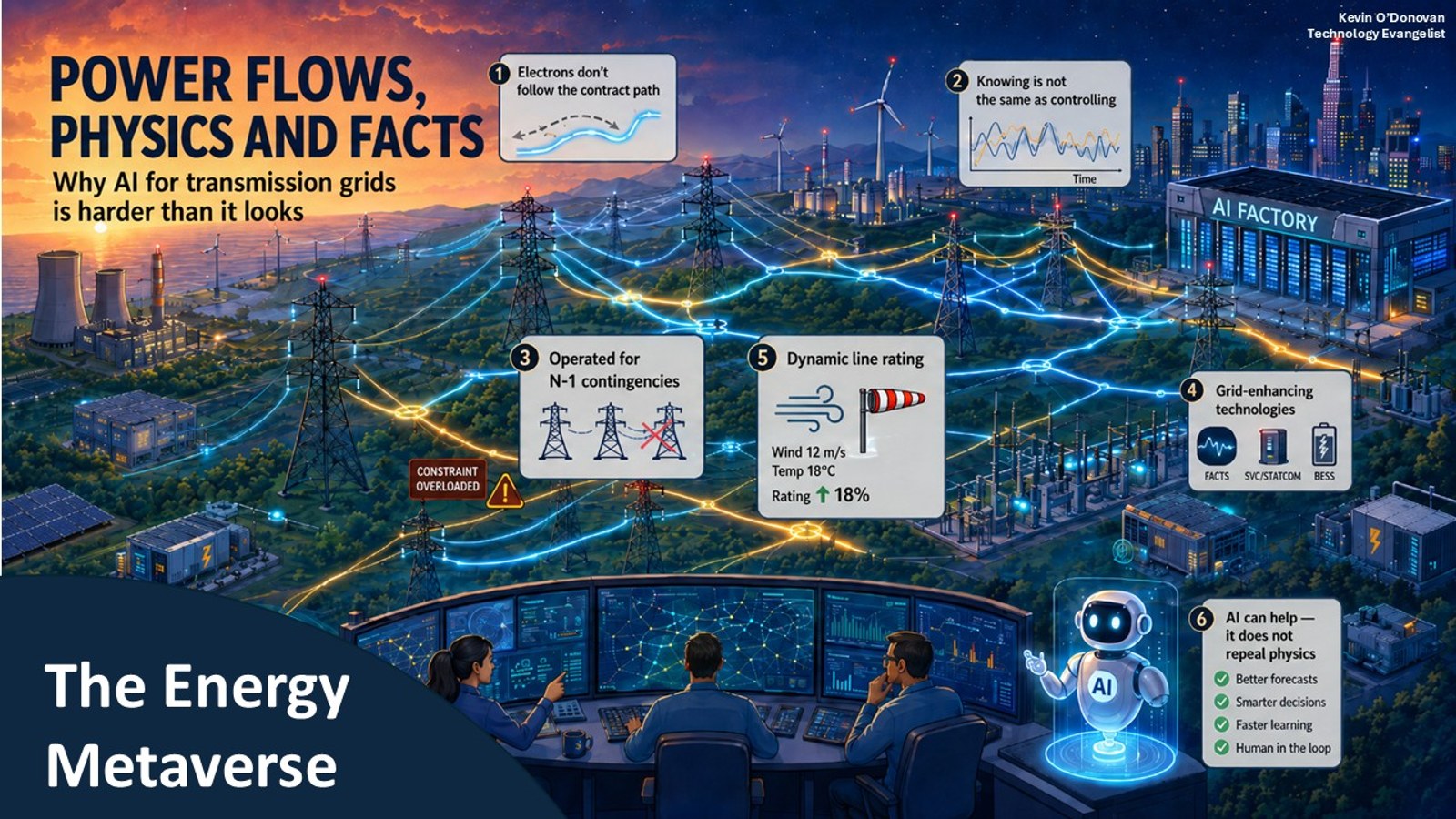 Image: AI generated via ChatGPT
I was recently involved in a workshop where the topic of conversation was on the transmission grid, the role of AI, and why modelling power flows is so complicated. Now most of the folks involved were not from the utility or power engineering world, yet the 'hard' question that kept coming up was, why is this so hard?
The context being, "if we know where the generation is, where the demand is, and what transmission lines connect everything together, surely we can model the flows, optimize the system, and let AI do its thing" ... Well, yes. And also, very much no.
Now before any of my power engineering friends start to get a bit 'anxious' 😉, let me be clear. I am not a power engineer. And while I've spent a lot of time around the world of grids, transmission networks, technology, digital twins, AI etc, I am NOT the guy you will have validating any protection settings or designing your transmission network.
So what follows is my way of explaining to folks who are not familiar with the world of transmission networks what is going on. Think of this as my version of a 101 primer.
And if I have missed anything, or there are any glaring errors in here, please do call them out !
The Basics
Because the more we talk about AI for the grid, the more we need to understand one basic point: the grid is not simply a bunch of expensive assets, or a nice architecture diagram. And it is definitely not a nice clean digital workflow where electrons can be routed like packets on the internet.
A transmission grid is a huge, synchronized, physical system. It is governed by electrical laws, thermal limits, voltage constraints, protection systems, market mechanisms, weather, asset condition, operational procedures, with the goal of keeping the lights on while all of this is happening in real time. That is the starting point people sometimes miss.
A lot of the AI-for-grid discussions I come across quietly assume that better prediction automatically means better control. But prediction is not the same as control. Modelling is not the same as operation. And a clever algorithm does not get to negotiate with Kirchhoff’s laws.
Electrons Don’t Follow the Contract Path
In a transmission network, electricity does not follow the contract path. If a generator in one region is commercially scheduled to supply demand somewhere else, the physical power does not 'politely' travel down the specific route written into the market arrangement. In a meshed AC grid, power flows through all available paths according to the electrical characteristics of the system. Impedance, voltage angles, network topology, generation dispatch, load conditions and the wider state of the grid all matter.
If there are two or three paths between where power is injected and where it is consumed, the flow will distribute itself across those paths. It might be 70/30. It might be 60/40. It might change five minutes later as demand changes, generation moves, a line trips, a transformer changes state, or the system operator makes some action.
Now to give you an idea, below is an image of Europe's Transmission System, one of the largest and more complex real-time systems on the planet. If you click on the image, it will take you to ENTSO-E's online map.
From ENTSO-E's Transmission System Map website
Kirchhoff Matters
Kirchhoff’s Current Law says that current entering a node must equal current leaving it. Kirchhoff’s Voltage Law says that the sum of voltage changes around a closed loop must balance. In plain English, the network has to obey the physics of a connected electrical system.
That sounds simple. It is not simple.
Transmission grids are not neat radial systems with one source and one load. They are large, meshed networks with multiple generators, multiple loads, multiple voltage levels, interconnectors, transformers, reactive power flows, protection constraints, stability limits, thermal limits and market-driven dispatch decisions layered on top. So when someone says, “just send more power from here to there”, the grid operator’s answer is not, “sure, no problem”.
It is more likely to be a long list of questions. What line does that overload? What voltage issue does that create? What happens if the next largest element trips? What happens if the wind forecast is wrong? What does this do to reactive power? What is the impact on a neighbouring control area? What does the commercial schedule say, and what will the physics actually do? And, the real 'tough' one, so what happens if the thing we do for this has consequences in another part of the network, and what will those consequences be?
Knowing the Grid Is Not the Same as Controlling It
This is where we need to separate three ideas that often get mixed together: knowing the grid, steering the grid, and safely operating the grid.
Knowing the grid means understanding the current operating state: what is connected, what is flowing, what the voltages are, what the constraints are, and where the risks may be.
Steering the grid means using physical assets, control systems, topology changes, phase-shifting transformers, FACTS devices, redispatch, HVDC links and other tools to influence what happens.
Safely operating the grid means making decisions that keep the system secure not only for what is happening now, but for what might happen next.
That distinction matters. A model may tell you what is happening. A control device may help influence what happens. But an operator still has to decide whether an action is safe, reliable, compliant and acceptable under real operating conditions. This is why terms like power-flow analysis, state estimation, PTDFs, optimal power flow and contingency analysis matter.
It's complicated
A power-flow model is trying to calculate the real and reactive power flows, voltages and angles across the network. In simplified terms, it asks: given this network, this generation, this demand and this configuration, where does the power actually go?
State estimation is the process of building a trusted view of the grid’s current condition from measurements, models, topology and telemetry. The control room does not simply “know” the perfect state of the grid. It estimates it, validates it and works with the best operational picture available.
A PTDF, or Power Transfer Distribution Factor, estimates how a change in generation and load affects flows on particular transmission elements. In over simplistic terms, if I inject more power here and withdraw it there, how much of that transfer shows up on each line?
Optimal Power Flow takes this further and asks: given all the physical constraints, operational limits and costs, what is the best operating point for the system?
The Grid Is Operated for What Might Happen Next
Then you have contingency analysis, like an N-1 principle. That means the system should be able to withstand the loss of one major component, such as a line, transformer or generator, without the whole system falling over. This is another thing worth remembering: the transmission grid is not only operated for what is happening now. It is operated for what might happen next.
A line may be within its limit right now. But if another line trips, the power that was flowing there has to go somewhere. It redistributes across the remaining network, and that redistribution can overload other assets. That is how cascading failures can begin. So the operator is not only asking “is this line safe now?” They are asking “is the system safe if the next credible thing goes wrong?” That is a very different question.
Capacity Is Not Just a Megawatt Number
This is also why “available capacity” is not just one number. Many non-grid people think of electricity as megawatts moving from A to B. That is part of the story, but AC transmission systems are also dealing with voltage, reactive power and stability. A line may look available from a simple megawatt point of view but still create voltage or stability problems elsewhere. Sometimes the constraint is thermal. Sometimes it is voltage. Sometimes it is transient stability. Sometimes it is oscillations, protection limits, fault levels or system strength.
So when someone says “but the line isn’t full”, the answer may be: full according to what constraint? Thermal? Voltage? Stability? Contingency? Market capacity? Operational security margin? Welcome to the fun and games.
Congestion Is Not Just a Traffic Jam
Then we get to congestion. Congestion is not just a traffic jam in the casual sense. It is a physical and operational constraint. A line, transformer, interface or stability boundary reaches a limit, and the system can no longer move additional power through that part of the grid without violating safe operating conditions.
That matters more today because the grid is being asked to do things it was not originally designed to do. We are adding more renewables, often far from traditional load centers. We are electrifying transport, heat and industry. We are connecting large new loads such as AI Factories, data centers, huge battery systems, hydrogen projects and industrial clusters ... the list goes on. We are retiring or reducing some traditional generation that used to provide inertia, voltage support and local balancing. We are expecting the transmission system to become a platform for a much more dynamic energy economy ... All good. All necessary. But not trivial.
So lets just Build More Lines? Yes. And Also, No.
This is why “just build more lines” is both true and painfully not a complete answer. Yes, we definitely need more transmission. In many regions, we clearly do. But new transmission is slow, expensive, politically difficult and often constrained by planning, permitting, land access, public acceptance and supply chain realities. So naturally, the industry is also looking at how to get more out of the grid we already have.
Grid-Enhancing Technologies:
This is where grid-enhancing technologies enter the story. But again, it helps to separate the categories. Some technologies help operators see things more clearly. Some help them use existing capacity more effectively. Some help them control or influence power flows better. Some can help them change the network configuration. Some help them connect new resources in a more controllable way. But they are not all doing the same job.
Phase-shifting transformers, for example, can influence active power flows by changing the phase angle between parts of the network. In very simple terms, they are one of the closest things the AC transmission grid has to a steering wheel.
FACTS devices, or Flexible AC Transmission Systems, use power electronics to help control voltage, reactive power, impedance and power flow. Some devices can influence the effective reactance of a line, which changes how attractive that path is electrically.
Series compensation, reactors, capacitors and other equipment can also change how power distributes across the network. Again, you are not routing electrons like internet packets. You are shaping the electrical landscape they flow through.
Topology optimization is another interesting one. Sometimes the best way to relieve congestion is not to add another line, but to change how the existing network is configured. In some cases, opening a line or changing switching arrangements can improve the overall flow pattern. That sounds counterintuitive, but networks are full of counterintuitive behaviour. The phenomenon of Braess’s paradox , originally from transport networks, tells us that adding a path can sometimes make the overall system worse. The grid has its own version of that “be careful what you add” problem.
Is HVDC the way to go? ... it depends.
And then there is HVDC. If you really want a more controllable point-to-point power transfer, HVDC is often the closest thing to a controlled pipe. It is not the same as a passive AC path. Converter stations allow much tighter control over how much power is transferred, which is why HVDC is so important for long-distance bulk transfer, offshore wind, interconnectors and asynchronous connections. But HVDC also means cost, complexity, converter stations, controls, protection and a different architecture. So unfortunately, it's not always the right answer. It depends.
So what about Dynamic Line Rating?
Dynamic Line Rating, or DLR, is often described as a way to unlock hidden capacity on existing transmission lines. That is broadly true, but the details matter. DLR does not steer power. It does not decide where electricity flows. It does not get around Kirchhoff's Laws. What it does do is help determine how much current a specific line can safely carry under actual or forecast conditions. It is a visibility and capacity-confidence tool.
Again to over simplify things, a transmission line has a thermal limit. As current flows through the conductor, the conductor heats up. If it gets too hot, it can sag too much, breach clearance limits, damage the conductor, or create safety issues. Traditionally, line ratings are often conservative. They may assume fixed weather conditions: a hot day, limited wind cooling, solar heating, and other assumptions designed to keep the line safe under reasonably adverse conditions.
But in the real world, the safe capacity of a line changes all the time. If the weather is cooler, if the wind is blowing across the conductor, if solar radiation is lower, the line may be able to carry more current safely than its static rating suggests. That is the basic promise of DLR: instead of treating the line as having one fixed capacity number, estimate its real-time or forecast capacity based on actual environmental and conductor conditions.
This can be very useful. If a line has more thermal headroom than the static rating says, operators may be able to reduce congestion, avoid curtailing renewables, defer redispatch, or make better use of an existing corridor. But, and there is always a but...
Dynamic Line Rating is very clever, but it is not magic. The rating of an overhead line depends heavily on the actual cooling conditions around the conductor, especially wind speed and wind direction. And wind does not behave neatly over a 20, 50 or 100 km line. It can change from span to span, valley to ridge, urban area to open field, and even with local turbulence around trees, buildings or terrain.
So while a model can estimate the thermal headroom on a line, the real question is whether it is seeing the conditions that actually matter at the limiting span. If the model assumes cooling that is not really there, the rating can become too optimistic. If it is too conservative, the operator leaves useful capacity on the table. That is why trust in DLR is not just about the algorithm. It is about sensor placement, validation, operational conservatism, and whether the system can prove that its rating reflects the real conductor, not just a nice weather model.
This is the point I have heard from some people back at DTECH in Feb, unless you are measuring what is happening along the line, especially at the critical spans, how confident can you be that the model reflects real-time conditions? Now this is not being anti-DLR. That is basic operational caution.
Now to be fair, DLR vendors and advocates have a good answer to that. They will say modern DLR is not simply “one weather station and a spreadsheet”. They will talk about sensor fusion, conductor temperature measurements, sag monitoring, tension data, local weather feeds, historical performance, forecasting models, critical span analysis, probabilistic ratings and conservative safety margins.
And IMO, they are right. A serious DLR deployment does not just average the weather across a line and call it a day. It will identify where the limiting conditions are likely to occur, instrument where needed, validate the model against real data, and give operators a rating they can actually trust. So the debate is not really “does DLR work?”
The better question is how accurately we can know the real limiting conditions, how conservative the dynamic rating should be, how we validate it, how operators trust it, and how it integrates into EMS, market systems, congestion management and operational decision-making. And that last point matters, because a DLR insight that sits on a dashboard but does not influence an operational decision is interesting, but not very useful.
This is why DLR is such a useful 'piece' of the wider AI-for-grid debate. The model may be clever. The forecast may be impressive. The dashboard may look super cool and the vendor demo may be super 'shiny'. But if the operator does not trust that it reflects the real limiting condition on the actual asset, the operator will not change the operational decision.
AI Can Help, But It Does Not Repeal Physics
So this is why I personally get a bit cautious when people jump too quickly to AI as THE answer. AI has a role huge role to play here, it can absolutely make things better. With better forecasting. It can help detect patterns. It can support anomaly detection, asset monitoring, congestion prediction, scenario analysis and operator decision support. It may help integrate weather, sensor, topology, market and asset data in ways that are much faster than traditional workflows. It may also help operators deal with the sheer complexity of the modern grid: more renewables, more distributed resources, more volatile flows, more electrification, more data, more constraints and more uncertainty. It's beings all sorts of new insights.
But simply adding AI is not a grid strategy.
As cool as all the AI tech today is, AI does not repeal Kirchhoff’s laws. Even some of the evolving new world model's do not magically know the real wind conditions around every conductor unless the measurement, data, physics and validation layers are there. Generative AI does not remove the need for power-flow analysis, state estimation, protection coordination, contingency planning, thermal modelling, voltage studies, stability analysis or operator trust.
This is where the industrial AI conversation has to stay grounded. In consumer software, being roughly right can sometimes be good enough. In transmission operations, being “roughly right” is NOT an option.
AI will be a huge help, but it's not magic.
Now I am still very optimistic on the impact of AI. AI is being wrapped around serious engineering models, operational data, physics-based simulation, real-time sensing and human expertise. Some of the new concepts around World models are super interesting.
But folks outside the utility sector sometimes underestimate how hard all this is to do. The grid is full of hidden complexity because it is a physical system that has to balance in real-time continuously, operate securely, withstand failures and serve society in real time. It does not get to stop, reboot and “try the model again”. If there is a failure, REALLY bad things happen, and happen in seconds.
So yes, we should absolutely look at how AI can improve the grid. We should talk about dynamic line rating. We should talk about grid-enhancing technologies. We should talk about better forecasting, smarter control rooms, digital twins, simulation, automation and more intelligent infrastructure planning. But we should also be honest about the starting point, Transmission networks are hard.
Today's Transmission Systems are incredible
As I said above, the transmission grids we have today are some of the most complex real-time systems on the planet. And while from time to time we see major blackouts that remind us just how unforgiving these systems can be, the fact that people keep these incredibly complex networks operating safely, reliably and continuously, 99% of the time, is frankly extraordinary.
And this does NOT happen by accident. It happens because of decades of engineering experience, operational procedures, planning discipline, control room expertise, protection systems, market mechanisms, simulation, forecasting, automation and a lot of technology that most people never see. The grid is not held together with hope and a dashboard. It is held together by people, physics, process and systems that have been refined over many years.
And now AI is becoming part of that story
As we all know, AI and Agentic AI is here to stay, and it is already starting to make an impact across many of the systems, processes and workflows used by utilities and transmission system operators. Look at what companies such as Siemens Energy, GE Vernova, Siemens, Schneider Electric, Hitachi Energy, OATI and many others are bringing to market for grid planning, grid insights, predictive maintenance, asset management, congestion forecasting, operational decision support and more. This stuff is not theoretical. It is already here, and will only get better in leaps and bounds..
Closing Comment
As I said from the outset, I was not trying to explain how the grid works to the people who run the grid. My point was to simply offer a bit of a 101 primer for the people I often meet in my world who quite reasonably ask why it is so hard to build, connect and operate all of this infrastructure.
And the simple answer is: because it is complicated. Really complicated. Not impossible. Not broken. Not stuck in the past. Just complicated in ways that are often invisible from the outside.
So before anyone assumes that AI will soon be running the grid, optimizing the grid or 'magically' unlocking capacity, we need to understand what is happening under the covers. The grid is physical. It is meshed. It is synchronized. It is constrained. It is safety-critical. It is operated by people who carry a huge amount of responsibility. And yet, somehow, incredibly, it works.
AI absolutely has a role to play, and IMO, it will be an incredibly important one. But the future is not AI replacing grid expertise. It is AI being layered onto serious engineering, trusted operational data, validated models, real-time sensing and human judgement.
Now as always, if I have made any glaring errors, missed something important, or oversimplified a point, feel free to call it out.
Kev.