
Article · Takeaways
Pipeline, Sovereign Cloud, and the Humanoid ecosystem: My Three Hannover Messe Takeaways
On my way to HANNOVER MESSE Messe recently, I was musing about the industrial metaverse stack. Yes, I know. Living the dream 🤓 ... But in all seriousness, the question I had going in was this: how do all the different bits and pieces now fit together?
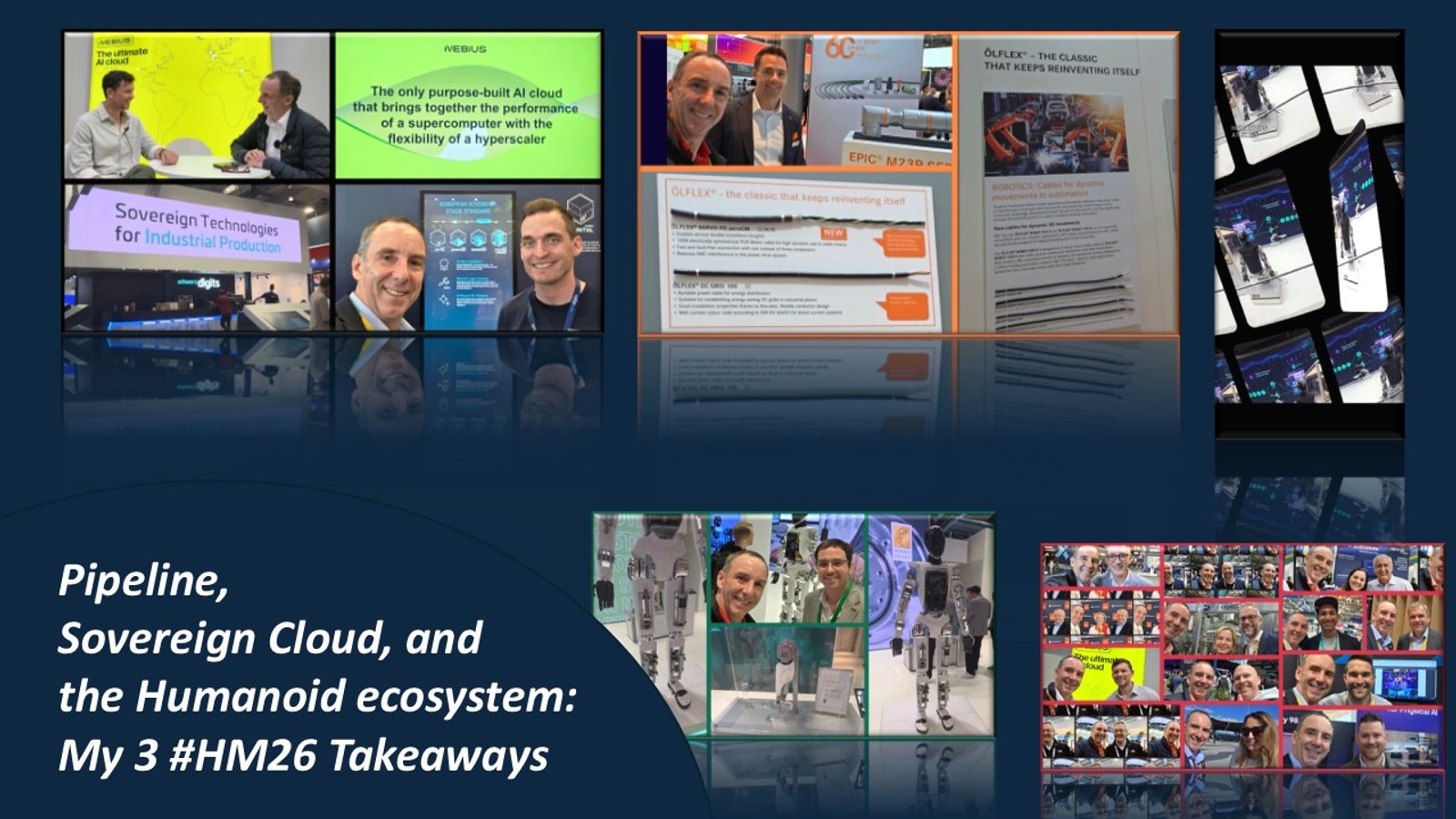 Image: Photos from Hannover Messe 2026
On my way toHANNOVER MESSEMesse recently, I was musing about the industrial metaverse stack. Yes, I know. Living the dream 🤓 ...
But in all seriousness, the question I had going in was this: how do all the different bits and pieces now fit together?
We have digital twins. We have simulation. We have AI. We have real-time operational data. We have 3D environments. We have robotics. We have edge systems. We have PLM, MES, SCADA, ERP, cloud, sovereign cloud, AI factories, and probably another dozen acronyms waiting patiently in the corner to ruin someone’s afternoon.
In many ways, this is the real convergence of technologies that people have been talking about for years. Not one magic platform suddenly replacing everything else, but multiple technologies, disciplines, data models, and engineering domains starting to overlap in ways that are becoming much harder to ignore.
So my thinking going into the event was very much around the stack. What are the layers? Where does each technology sit? How does this sit alongside established architectures like ISA-95, RAMI 4.0, or the usual IT/OT models? And, more importantly, how do we talk about this in a way that is useful, rather than just building yet another beautiful diagram that nobody can actually implement?
But after a week of walking the halls, chatting with folks from all sorts of companies, and seeing what is now moving from PowerPoint into the real world, I think my thinking shifted slightly.
The stack still matters. Architecture still matters. Standards still matter. But the other angle here is the pipeline.
And that, I think, was my broader takeaway from Hannover Messe this year. A lot of the conversation is becoming much more practical. Less “what could this become?” and more “what has to exist under the covers for this to actually work?”
That applies to the industrial metaverse. It applies to sovereign cloud. And it absolutely applies to humanoids.
1. The pipeline may matter more than the stack
When I talk about the pipeline, I’m talking about how data, context, and logic actually 'flow'.
Not just where systems sit in an architecture diagram. Not just what layer something belongs to. Not just whether something is cloud, edge, on-prem, brownfield, greenfield, digital twin, industrial AI, or whatever other label we decide to put on it this week. The real question is: how does the data move?
How does engineering data flow into simulation? How does simulation connect to operations? How does real-time shopfloor data enrich the digital twin? How does that digital twin then inform maintenance, production planning, robotics, training, or AI agents? How does a change in one system propagate into another without someone manually copying a spreadsheet, exporting a file, or praying that the integration still works after the next software update?
That, to me, is where the conversation becomes more interesting.
Now the wordpipelineis not new. Industry has always had pipelines, production lines, process flows, supply chains, and value streams. The word comes from the very practical idea of moving something from one place to another. But the way I am using it here is closer to how the term is used in graphics, VFX, software, and data engineering: a managed flow of data, assets, context, logic, or work products through a set of tools, transformations, and decision points.
In graphics, a rendering pipeline turns a 3D scene into an image. In data engineering, a data pipeline moves and transforms data from source systems into something useful.
And NVIDIA usespipelinelanguage heavily around AI, but usually in practical engineering contexts rather than as a broad industry-theory term. They talk aboutsynthetic data generation pipelines,AI training pipelines,inference pipelines,simulation/testing/validation pipelines, andsim-to-real pipelinesfor robotics and physical AI.
My point is simply that, in the industrial metaverse conversation, we may need more of that same lens. Not just asking what systems we have, or where they sit in the stack, but how information, simulation results, digital twin updates, AI context, and operational decisions actually move between them. So no, pipeline is not a new term. But it may be a useful way to make the conversation more practical.
The pipeline IMO is a good way to look at how stuff works. It asks what moves, when it moves, who consumes it, what triggers it, what updates, what breaks, and what becomes automated because that connection now exists.
For example, a design change in engineering should be able to update the simulation model, inform the manufacturing process, change the training environment, update the digital twin, and eventually influence what an AI agent or robotic system understands about the asset or process.
That is easy to say. It is brutally hard to do. But that is exactly why the pipeline matters.
Because in the industrial world, we have spent years talking about digital threads, digital twins, comprehensive digital twins, model-based engineering, data standards, and connected ecosystems. All of that is valid. But unless the pipeline is there, unless the data and logic can move through the environment in a meaningful way, the whole thing risks becoming a collection of impressive but disconnected silos. And let’s face it, the last thing we need is more silos.
So in my thinking, this is where the difference between architecture, stack, and pipeline starts to matter.
An architecture gives you the structure. It tells you how the world should be organised.
A stack gives you the layers. It helps you understand what capabilities sit where.
But the pipeline is what makes it move.
It is the thing that turns the industrial metaverse from a clever concept into something operational. It is how data moves between digital twins. It is how applications share context. It is how AI gets access to the right information at the right time. It is how simulation connects to real-world operations. It is how you start moving from static models to living systems.
And this is also where standards become very real, very quickly.
Because if the pipeline depends on bespoke integrations, custom connectors, heroic engineering, and three people who know how the old system works, then we are not really building an industrial metaverse. We are building another integration project with better graphics, held together by sticky tape.
So yes, the stack matters. Yes, the architecture matters. But coming out of Hannover Messe, I am more convinced than ever that we need to spend a lot more time talking about pipelines.
2. European sovereign cloud is no longer just a footnote
The second thing that stood out to me was European sovereign cloud. And I’ll be honest. I was not as up to date on this as I probably should have been.
I knew, of course, that sovereign cloud had become a huge topic here in Europe. That has been obvious for a while. Data sovereignty, regulatory concerns, resilience, critical infrastructure, national capability, AI infrastructure, geopolitical risk — all of these things have pushed the topic up the agenda.
Because I had probably been guilty of putting some of the players I met in Hannover into the “hosting” or “neocloud” bucket. Useful, important, but maybe not yet offering the kind of broader capability you would associate with the big hyperscalers.
So I met up with Schwarz Digits and Nebius. For transparency, I spent time talking with the team at Schwarz Digits, and I spent quite a bit more time with Nebius during their press event and an afternoon briefing session, plus I interviewed one of their team (video to follow).
What I was not fully aware of was the depth of the stacks they both offer today. And for European industry, this matters.
Where does the data sit? Who controls it? Where is the compute? What happens when industrial data, AI workloads, engineering IP, operational data, and simulation environments all start to converge? What does sovereignty mean when the workloads are no longer just emails, documents, and business applications, but factory models, robotics data, AI training data, and potentially critical infrastructure operations?
This is where the sovereign cloud conversation gets very real. It is no longer just a policy conversation. It is an industrial competitiveness conversation.
Now, let’s not get carried away. None of this means the European players have magically caught up with the breadth, maturity, and ecosystem scale of AWS, Azure, or Google Cloud etc.
Thanks toEvan HeldaatNebius&Clemens ZurwestenatSchwarz Digitsfor taking the time to chat last week. Much appreciated.
Taken at Hannover Messe 2026
The established hyperscalers still have enormous service catalogues, mature developer ecosystems, global reach, partner networks, procurement relationships, and enterprise adoption. Nobody should pretend otherwise. But it does mean the conversation is no longer simply “US hyperscaler or nothing.”
For certain workloads, certain sectors, certain sovereignty requirements, and certain AI infrastructure use cases, European options are becoming much more crediable.
For me, that was a genuine wake up call ... because in a world where industrial AI, digital twins, simulation, robotics, and sovereign compute are all starting to collide, that is well worth paying attention to.
3. Humanoids are not just about the robot brain
My third takeaway was on the humanoid ecosystem that's rapidly evolving.
There is no doubt that humanoids are 'cool'. They attract attention. They get people to stop at booths. They make great videos. They trigger the usual mix of excitement, skepticism, fear, hype, and “yes, but can it actually do anything useful?” that comes with any emerging technology that looks like it has walked out of a science fiction movie.
But what interested me most at Hannover Messe was not just the humanoid itself. It was the ecosystem rapidly evolving around them.
And before anyone gets too carried away, I am not saying humanoids are automatically the answer. In many industrial settings, they may not be.
A purpose-built machine, cobot, AMR, gantry, or fixed automation cell may be cheaper, safer, faster, more precise, and more reliable. The humanoid argument only really becomes interesting where the environment, tools, and workflows have already been designed around humans, and where flexibility is worth more than pure repeatability. That is the bit we have to keep in mind.
Because otherwise we end up in the usual hype cycle where every problem suddenly needs a humanoid-shaped answer, which is about as sensible as solving every transport problem with a helicopter. But if humanoids are going to become useful in industry, then we need to look beyond the brain.
We spend a lot of time talking about the AI. The foundation models. The vision-language-action models. The ability to reason, perceive, plan, and act. And yes, all of that is absolutely critical. Without the intelligence layer, modern humanoids do not become much more than expensive mechanical theatre.
But here is the thing. You can have the most brilliant AI in the world, the cleverest robot brain, and the most impressive demo script. But the humanoid still has to move.
It has joints. It has actuators. It has motors. It has cables. It has sensors. It has materials. It has connectors. It has thermal constraints. It has EMC issues. It has mechanical constraints. It has energy constraints. It has durability challenges. It has to bend, twist, reach, walk, carry, recover, repeat, and do all of that without falling apart after a few thousand cycles.
And that is where the industrial ecosystem becomes very interesting.
The same companies that have spent decades solving motion, reliability, materials, cabling, connectors, sensors, bearings, electronics, and manufacturability for industrial automation now have a role to play in whether humanoids ever become useful outside the demo zone.
Schaeffler was a very good example of this. The company won the 2026 HERMES AWARD for a scalable actuator platform for humanoid robots. That matters because actuators are not exactly the glamorous part of the humanoid story for the general public. But without such tech, nothing moves. I also spent time on the Schaeffler booth looking at their humanoid demonstrator and talking through the different bits and pieces that sit behind the movement.
When you see the actuators, motors, joints, electronics, and mechanical design laid out as part of the humanoid story, it becomes very obvious that motion, control, materials, reliability, and manufacturability are key features here.
A shout-out to Philipp Mattes fromSchaefflerfor a great chat there last week
From the Schaeffler booth at HM26
The same applies to cables from the likes of LAPP. Even something as apparently simple as cable technology becomes incredibly important in robotics.
A cable in a robot arm or humanoid is bending, twisting, flexing, and repeating that movement again and again and again. Potentially millions of times, while dealing with noise, electromagnetic interference, flexibility, durability, space constraints, thermal conductivity, and reliability.
Thanks toLukas KirdenfromLAPP Groupfor all the explanations re their latest and greatest innovations.
On the LAPPP Group booth at #HM26
Then you have companies like igus, where the materials side becomes just as interesting. Because humanoids and robots need to be lightweight, durable, flexible where needed, rigid where required, and cost-effective enough that this entire humanoid category does not remain caught in the "that's really impressive tech, but it's WAY too expensive..."
And then, of course, someone has to put all of this together.
That is where companies likeHumanoid,Oversonic,NEURA Robotics,Hexagon Robotics,Unitree Roboticsand 100s more come into the picture. They are not just building a robot. They are integrating an ecosystem. AI, mechanics, electronics, actuation, cabling, materials, software, safety, deployment, maintenance, and eventually fleet orchestration.
Because if humanoids are going to become relevant in industrial environments, the breakthrough will not come from AI alone. It will come from the combination of AI and industrial-grade engineering of some of the boring-but-critical components that make the thing reliable, safe, maintainable, and economically viable.
Here 👇 are 25+ different humanoids I came across there.
So coming away from Hannover Messe ...
The industrial metaverse conversation is moving from architecture and stack diagrams toward pipelines: how data, logic, and context actually flow between systems.
The European sovereign cloud conversation is moving from policy and positioning toward real industrial capability: the cloud, compute, and AI infrastructure options that European companies should increasingly consider.
And the humanoid conversation is moving beyond the visible robot toward the deeper ecosystem: actuators, motors, cables, materials, electronics, software, integration, and the industrial know-how required to make these things useful in the real world.
And that, for me, is why Hannover Messe remains a cool event. It is one of the few places where you can see the big strategic themes, the practical industrial plumbing, some of the seemingly 'boring stuff', and the 'art of the possible' future-facing innovations all sitting beside each other.
The Industrial Metaverse will not be realized by one technology, one platform, one model, or one magic layer in the stack. It will be built by the pipelines, the infrastructure, and the ecosystems that allow all of these pieces to work together.
And if Hannover Messe showed me anything this year, it is that those pieces are starting to come together. Not perfectly. Not cleanly. Not without a lot of integration 'features' ahead, but they are coming together.
My two cents
Kev.