
Article · Podcast Appearance · Explainer
The Industrial Metaverse: Digital, Immersive and Very Much Alive
The metaverse never really went away. It has been quietly evolving into something more tangible, as digital twins, simulation, spatial computing and AI converge across industry.
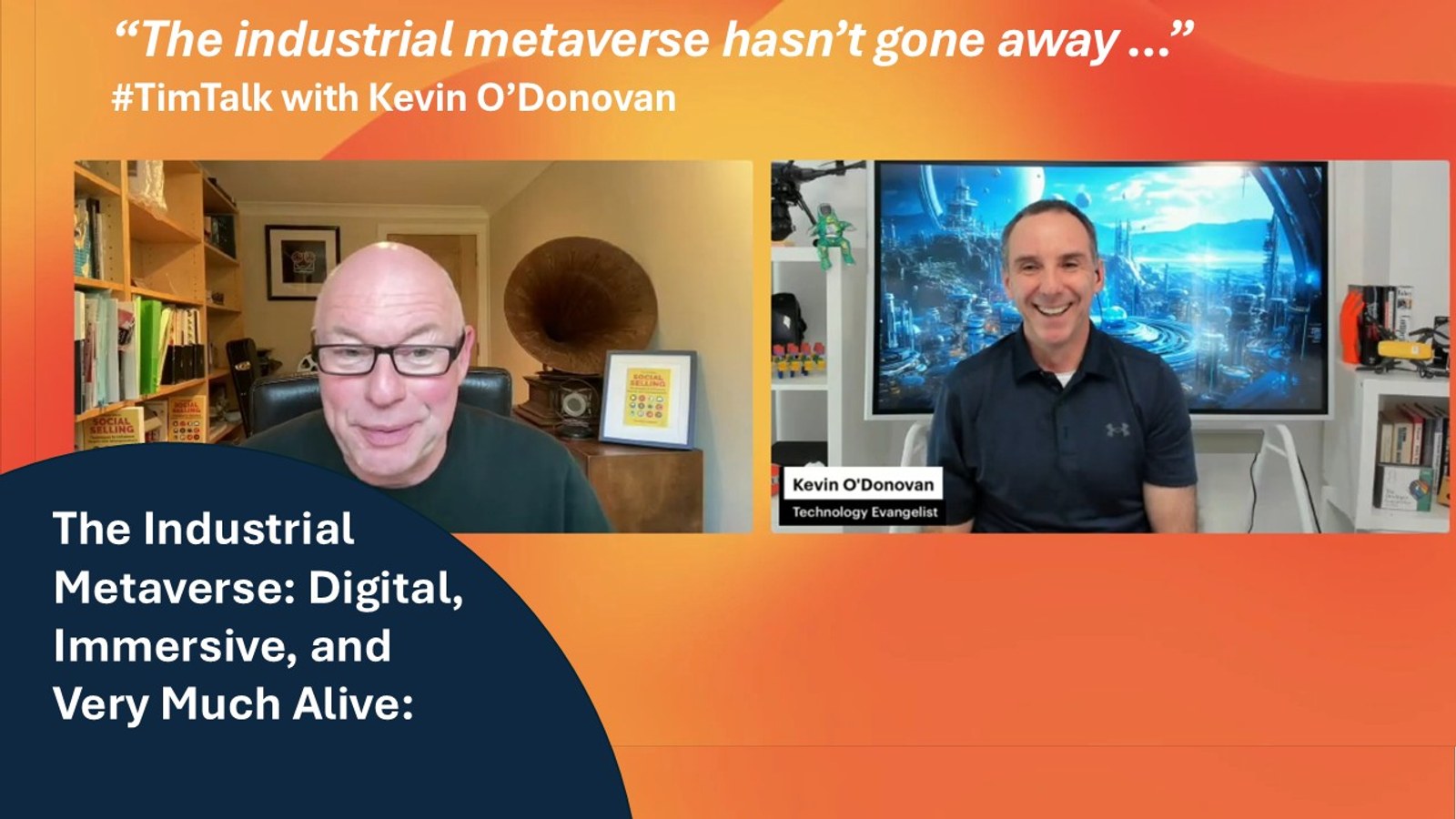
I recently had the opportunity to join Timothy “Tim” Hughes on his #TimTalk podcast, and the topic of conversation was: what happened to the metaverse?
Remember that? The word that got everyone excited back in 2021, before, as Tim said, AI came along and stole the limelight?
Well, as I told Tim, the metaverse never really went away. It’s just been quietly evolving. And in many ways, it’s evolved into something far more tangible, especially the Industrial Metaverse.
Now, whether “industrial metaverse” will even be the right term we all use in five years’ time is up for debate. We’ve been talking about Industry 4.0 for years; some folks are already talking about Industry 5.0. And we’ve had digital twins, virtual factories, smart manufacturing. The list goes on. Pick your buzzword. But regardless of what we call it, this evolution is not going away.
The characteristics of the Industrial Metaverse
When Tim asked me about the key characteristics of what we call the Industrial Metaverse, here are the ones I called out.
Digital first, spatial next
In the industrial world today, everything starts digital first. We’re designing in digital, simulating as much as we can before anything gets built. Then, once built, we capture as much data as we can through IIoT and real-time data.
But increasingly, it’s not just digital data. It’s spatial data. We’re talking about 3D models, photogrammetry, LiDAR scans, point clouds, and now quick phone videos turned into full-blown 3D environments with Gaussian splats.
That’s where things get immersive. And here’s the thing: immersive doesn’t automatically mean strapping on a VR headset and wearing a haptic suit while running on a multidirectional treadmill. Immersion is a spectrum.
We’ve gone from paper drawings to 2D screens, to interactive 3D models we can all explore, whether that’s on a 2D screen, on a 3D monitor or through some sort of XR device. I could be looking at a digital model of a wind farm in Ireland, while someone else in Germany or the US looks at the exact same model, all of us using different technologies. That’s immersive collaboration.
And yes, with the arrival of Ray-Ban Meta glasses and similar devices, that spectrum is expanding fast. What once looked like science fiction may well be on the way to being seen as mainstream consumer tech: lighter, smarter, smaller and increasingly conversational.
And let’s see what gets announced at CES 2026 in a few months. Immersive computing is no longer niche.
Persistent
The other defining trait of this Industrial Metaverse idea is persistence. If I’m working in a digital environment, say reviewing a virtual factory layout, that data doesn’t disappear when I log out. It’s stored, updated and ready for the next person who jumps in. Leave a virtual sticky note saying “check this conveyor alignment,” and someone else can act on it hours later.
Simulation is everything
I told Tim this isn’t just about creating nice 3D visuals or glossy fly-throughs of a new factory. Simulation is absolutely key. It’s about building physics-based models that let you test, validate and optimise every part of the product lifecycle, from design and construction through to operation and maintenance.
Whether you’re checking stress tolerances, testing new production rates or running predictive maintenance scenarios, the value comes from being able to simulate the real world before anything physical happens.
Collaborative
And all of this has to be collaborative. We’re not in isolated apps anymore. Whether I’m wearing XR glasses, working on a desktop or phone, or standing on a plant floor, I’m collaborating with others in the exact same shared digital environment.
Breaking down the silos, with AI to the rescue
Now, all of these concepts and characteristics aren’t new. They’ve been talked about for years. The real issue is that they’ve been incredibly hard to pull off until now, mainly because we simply didn’t have the technology. More importantly, we didn’t have access to all the data. The biggest barrier has always been data silos.
And that’s the huge challenge. For years, we’ve talked about “breaking down silos,” and yet most organisations still operate with them. Every team has its own digital twin, its own system, its own so-called “source of truth.” One for design, another for real-time IoT, another for operations. The result? More silos than ever.
But things are changing fast. Open architectures, APIs and standards like OpenUSD are finally starting to stitch those islands together. Platforms like NVIDIA Omniverse, Bentley iTwin and Amazon’s industrial IoT stack are helping make data interoperable across systems.
In the past, we built monolithic enterprise systems that took years to integrate. By the time they worked, something else had already changed. Today, it’s all about modular, API-driven connections. The digital thread, connecting multiple digital twins, is becoming real.
And ironically, it’s AI that’s accelerating this. To make AI genuinely useful, companies are realising they have to unify their data. You can’t train smart systems if half your information is locked away in forgotten servers. So, in chasing AI, we’re finally fixing one of industry’s oldest problems.
The convergence game
We’re in the middle of a technological convergence unlike anything we’ve seen before. Compute power has exploded, from the edge all the way to the cloud. You can now run advanced AI models right on the factory floor, thanks to powerful industrial PCs that now ship with GPUs built in.
Add to that better sensors, smaller chips, faster connectivity and more capable simulation tools, and the pace of change is staggering. That’s why, when people ask me “is the metaverse still a thing?”, I tell them it’s everywhere, just under different names. The convergence of spatial computing, simulation, AI and digital thread is the Industrial Metaverse.
The human element
Of course, technology is only half the story. The other half, and arguably the hardest part, is us humans.
We’re facing a skills shortage across manufacturing, energy and infrastructure. You can automate production lines, but you still need people who understand how to design, monitor and adapt those systems. So, we’re seeing the rise of micro-learning, immersive training and digital collaboration tools designed to upskill teams continuously.
And this is where I think the idea of digital coexistence comes in. For 20 years we’ve been talking about digital transformation, but transformation implies an end point. Coexistence acknowledges that humans and digital systems will be intertwined indefinitely. We’ll have AI copilots, digital twins and autonomous processes all working alongside us, not replacing us.
Dark factories may exist in theory, but the reality is, humans still need to be in the loop. Whether that’s for fixing robots, validating AI decisions or managing exceptions, there’s always a human hand on the tiller.
And it’s not just a technology play. It’s about being competitive.
When I talk to executives today, the message I keep hearing is simple: we have to stay profitable, flexible and ready for whatever’s next. As we’ve all seen, supply chains are shifting, and geopolitics are unpredictable to say the least.
To keep up, companies need digital foresight: real-time visibility into operations, simulation capabilities to test ideas and the agility to pivot on demand. “Batch size of one” manufacturing isn’t just a buzzword anymore. It’s becoming a survival strategy.
That’s why all of this, digital twins, immersive design, AI and simulation, isn’t just tech for tech’s sake. It’s about competitiveness, efficiency and adaptability.
Looking ahead
As Tim said at the end, we’ll probably laugh at ourselves in five years. We’ll look back and say, “Did we really call it the metaverse?”, just like we once called the internet the “World Wide Web.”
But whatever label we give it, the trajectory is set: digital first, simulated, immersive, automated and AI-enhanced.
For me, that’s the real story here. Not hype, not marketing spin. It’s the steady merging of technology and business reality. So buckle up.
Whether you want to call it the Industrial Metaverse, Industry 5.0 or digital coexistence in the 21st century, we’re only just getting started. It’s going to be one hell of a ride.
Thanks again to Tim for the invite and the chat. I enjoyed it.
Kev.