
Article · Takeaways
ADIPEC 2025: Bigger, Bolder and Focused on Autonomous Operations
My takeaways from ADIPEC 2025: the push toward autonomous operations, the energy demands of AI factories, robotics in the field and the unsettled question of who will capture AI’s value.
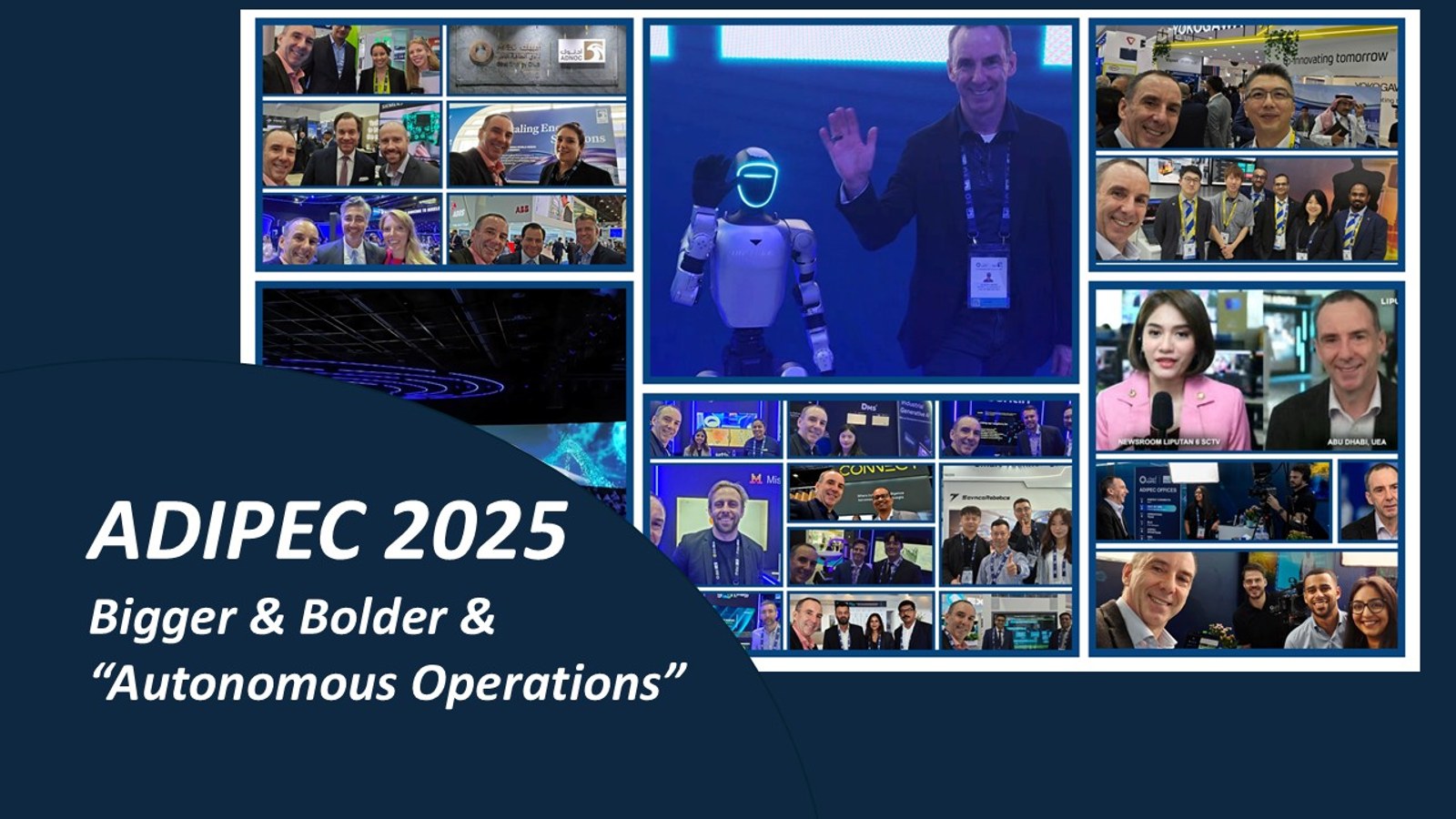
“ADIPEC 2025 will be bigger and bolder than ever before.” — Thomas Löffler
As Thomas Löffler said to me before the event, ADIPEC 2025 would be bigger and bolder than ever before. And he was right. It was.
For anyone who hasn’t been, think roughly 200,000 visitors over four days, around 1,800 exhibitors and some 2,000 speakers. So there is a lot going on.
While I had a very productive and fun few days there, I certainly did not see and hear everything that was happening. But based on what I did see and hear, these are my key takeaways.
1. Autonomous operations: the theme of the week
My biggest surprise was the huge push toward autonomous operations, primarily driven by business requirements from the likes of ADNOC Group and other large Gulf players that want facilities to be as autonomous as possible.
How far you can go in making any facility autonomous depends on the specific facility, of course. But multiple projects are being planned, focused on making facilities, or parts of them, significantly more autonomous. The reasons range from geopolitics to workforce skills: the usual mix of hard, pragmatic drivers.
From my perspective, if you want autonomous operations, everything has to work together. That means IoT, SCADA and real-time monitoring. It means breaking down data and company silos. You need to train the AIs, deploy agents and bring robotics into the loop.
It’s digitalization on steroids. Call it Industry 4.0, 5.0, the Industrial Metaverse, the Energy Metaverse or whatever your buzzword of choice.
But it is a massive undertaking. And yes, everybody was talking about it: Siemens, ABB, Yokogawa, Schneider Electric and more.
Talking about it is one thing; delivering it is another. Yet there’s a maturity model here, and some tasks are easier to automate than others. Either way, this is being led by a very strong customer and business pull that’s forcing all the latest and greatest AI, GenAI, robotics and autonomy to converge.
Given the scale of the current projects up for grabs, this one is going to be fascinating to watch.
2. AI data centres and AI factories: a hot topic, literally
The second theme won’t surprise anyone: AI data centres, or AI factories if you prefer. This was a hot topic, literally and figuratively.
In the strategy sessions, you could see different ideologies and geopolitics on display. But the net-net is simple: the energy needed to run data centres is a double-edged sword.
It pushes hard on existing energy and grid resources, but the output from AI factories matters. It enables better language models, which in turn can lead to better automation, better grid management and new materials discovery for batteries and transmission.
But it’s still a chicken-and-egg dilemma for many: whether to invest in AI versus everything else we need.
One thing I appreciated in the opening keynotes was that the demand for energy was not restricted to the need to power AI factories. Many called out that urbanisation continues at pace, with another 1.2 billion people moving to cities in the next 10 to 15 years. That means, for example, way more air conditioning.
Huge amounts of electrified manufacturing are planned, much of it being reshored, as is the electrification of transportation.
So the phrase of the week for me was “energy addition.”
Plenty of people are still talking about the “energy transition,” while there were a few fringe voices telling us that the transition is over. But in my opinion, we need everything, and lots of it: more renewables, more gas and LNG, more geothermal, SMRs, you name it.
3. Robotics everywhere
Robotics got a lot of attention, largely because of the autonomy theme, especially when it came to humanoid robots.
You couldn’t miss Unitree’s presence, with a good few G1s around. They’re genuinely impressive pieces of kit. But let’s be honest: in my opinion, you’re not going to see a G1, as it exists today, running around an offshore platform or inside an energy substation any time soon.
But you will, or should, see one appearing as a development platform in every R&D department. And while there is a long waiting list, you can order a G1 today. Budget roughly €15,000 to €20,000 for the base unit.
The G1 is a great way to learn about humanoid robots, great for demos and absolute eye candy from a marketing perspective. If you invest more to get the development kit, then you can start to programme your own use cases.
And that’s where the real value is right now. Teams need to figure out how to work with devices like these: how to integrate them into IT and OT, how to approach cybersecurity, how to mount their own sensors, and how to run their own language models and agents on these mobile platforms.
Credit where it’s due: Wassim Ghadban and the team at Kent did a great job. Their G1 was front and centre in the AI Zone, and they had it out and about on the show floor. They certainly get credit for showing people the art of the possible today.
Beyond humanoids
It was not just humanoid robots. There were all sorts of walking, flying, crawling, floating and swimming robotic and drone solutions on show.
One that specifically caught my eye was Sevnce Robotics from China, a company I hadn’t come across before. They have a range of 12 explosion-proof robots already in the field.
According to the company, roughly 3,000 units are deployed across China with many of the major Chinese energy, grid and chemical players.
These are not exactly built to win any robot beauty contests. They’re built to work in explosive environments. Different design choices, but very practical. Worth keeping an eye on.
4. AI is everywhere, but the money question isn’t settled
AI was everywhere, as expected. Yet the more interesting debates revolved around what kind of AI, for what use case, and who is actually going to make money from it.
While there’s a lot of fun and games these days talking about the “AI bubble,” the question of how, and who, will monetise all this in energy and industry is interesting to observe.
AI is here to stay. Yet questions about who is going to capture the value, and which business models will succeed, are keeping people busy these days.
5. A few closing points to mull over
First, the autonomous operations push will force organisations to tackle long-standing integration problems.
If you want robots, agents and AIs to do meaningful work safely, you have to join the dots across IoT, SCADA, real-time monitoring and the data silos you’ve been meaning to deal with for years. The “digitalization on steroids” line isn’t just a buzzword anymore.
Second, the energy addition narrative was the most honest I’ve heard in a while. Urbanisation, reshoring, the electrification of manufacturing, EVs and AI factories are all piling onto the same grid and the same supply chains.
It’s not going to be either/or. It will be “and.” The buildout of both power generation and the grid is going to be centre stage for the next few years at least.
What else I got up to
I squeezed in a bunch of conversations and interviews during the week with the likes of Nefeli Moridis, Ph.D. at NVIDIA; the team at Yokogawa; Helmut von Struve and Pascal Le Gal at Siemens; Gino Hernandez at ABB; Devan Pillay and Gaurav Sharma at Schneider Electric; Josh Brumberger at Utilidata; and people from Kent, Mistral AI and many more.
The themes were consistent: autonomy, AI factories, robotics and the operational realities of stitching it all together, especially the human factor. I should have many of these published in the coming weeks, so keep an eye out for them.
Getting interviewed by Gracia Bern Tobing for Malaysian TV Liputan6.com in its ADIPEC studio was pretty cool too.
So those were my takeaways. If you were there, I’d be curious to get yours.
ADIPEC Exhibition and Conference 2025 really was bigger, bolder and busier.
Kev.